Developers of Chicago Engineering Blog
What OpenAI's latest controversy tells us about the future of math

Introduction
For centuries, pure mathematics has been viewed as the pinnacle of human cognitive achievement. Unlike empirical sciences, which rely on physical observation and experimental measurement, theoretical mathematics demands absolute logic, creative abstraction, and undeniable proof. When OpenAI announced that its latest autonomous reasoning agents had successfully solved one of the famed Millennium Prize Problems, it was supposed to be a historic victory—a watershed moment marking humanity's transition into an era of machine-driven scientific discovery.
Instead, the achievement was almost instantly engulfed in fierce debate. Within hours of the announcement, mathematicians, computer science researchers, and AI ethicists raised critical questions regarding training set contamination, logic verification, and the attribution of human academic work. The controversy has ignited a broader conversation about how machine learning models generate novel insights, how we verify complex output from black-box systems, and what "discovery" actually means in the age of artificial intelligence.
This moment matters far beyond academic mathematics. The mechanisms OpenAI used to tackle advanced mathematical proofs are the exact same architectural approaches being deployed in enterprise software, automated software engineering, algorithmic finance, and biomedical research. How the tech community resolves this controversy will set the rules for AI-assisted research, intellectual property, and automated reasoning across every industry for decades to come.
What Happened
The announcement began with extraordinary promise. OpenAI published a technical paper and accompanying demonstration claiming that a specialized fleet of reasoning agents, built upon advanced reinforcement learning and tree-search algorithms, had produced a complete, verified proof for a Millennium Prize Problem—a set of seven monumental mathematical challenges established by the Clay Mathematics Institute in 2000, each carrying a $1 million prize for a correct solution. Prior to this, only one problem, the Poincaré Conjecture, had ever been solved, and that was by human mathematician Grigori Perelman in 2003.
OpenAI claimed its system was able to navigate complex mathematical spaces without human intervention, self-correcting its logical trajectories and outputting code in formal proof languages like Lean. According to OpenAI, the model spent equivalent thousands of compute hours exploring theoretical branches before arriving at a closed-form logical proof that passed automated verification compilers.
However, the scientific community’s celebration was short-lived. Independent researchers quickly scrutinized the published proof and the underlying training data. Critics raised three primary objections:
- Training Data Contamination: Several key lemmas and intermediate logical steps in the AI's proof closely mirrored obscure, unverified pre-print papers published on arXiv by human researchers over the past decade. Critics argued the model had simply memorized and synthesized human work rather than engaging in true mathematical reasoning.
- Verification Obfuscation: While the output was validated by automated formal proof checkers, human mathematicians pointed out that the generated Lean code was unreadable—a dense "spaghetti logic" that technically satisfied symbolic rules but provided zero human-understandable theoretical insight into why the solution worked.
- Overstated Autonomy: Industry insiders leaked reports suggesting that human domain experts had heavily structured the prompt sequences, hand-curated the formal logic environment, and manually pruned dead-end branches during the computation process, contradicting OpenAI's narrative of fully autonomous discovery.
Key Details
To understand the scope of this controversy, one must look at the underlying technology and the scale of execution. OpenAI leveraged a sophisticated multi-agent paradigm combining large language models (LLMs) with formal methods and deep reinforcement learning. Rather than relying purely on standard natural language processing—which is notoriously prone to logical hallucinations—the system integrated directly with formal interactive theorem provers (ITPs) such as Lean and Coq.
In formal mathematics, an ITP acts as an uncompromising compiler. A model cannot simply hallucinate a claim; every single step of a proof must be translated into formal code that abides by strict axiomatic rules. OpenAI’s agents used Monte Carlo Tree Search (MCTS) combined with value networks to explore millions of possible logical steps per second, using the formal compiler as a real-time feedback mechanism to penalize invalid logic and reward progress toward the goal.

View ASCII source
[Prompt / Problem Statement]
             │
             ▼
┌───────────────────────────┐
│   OpenAI Reasoning Agent  │ ◄─── Deep Reinforcement Learning
└────────────┬──────────────┘      & Monte Carlo Tree Search
             │ (Generates Logical Step)
             ▼
┌───────────────────────────┐
│  Formal Proof Engine      │
│     (Lean / Coq)          │
└────────────┬──────────────┘
             │
      ───────┴───────
     │               │
 (Valid Step)  (Invalid Step)
     │               │
     ▼               ▼
[Advance Search] [Prune & Retry]
The scale of compute deployed for this experiment was immense. Reports indicate the run consumed millions of dollars in cloud infrastructure overhead, drawing on tens of thousands of specialized GPUs working in parallel over several weeks. This was not a standard inference call; it was a brute-force statistical exploration of formal logic spaces backed by massive compute infrastructure.
The controversy highlights a critical tension between two major tech philosophies: symbolic AI (which relies on deterministic, rule-based formal logic) and connectionist AI (which relies on deep neural networks learning patterns from data). OpenAI attempted to bridge this gap, but the resulting backlash demonstrates that merging statistical pattern recognition with strict mathematical rigor remains a complex, highly fraught discipline.
Impact on the AI Industry
The fallout from OpenAI's mathematical controversy is causing ripples across the entire technology landscape. For years, AI performance has been evaluated using standard benchmarks like MMLU (Massive Multitask Language Understanding) or high school math competitions like the GSM8K. As frontier models saturate these public benchmarks, tech giants have pivoted to research-grade problems to prove the superiority of their reasoning architectures.
This controversy marks the end of simple benchmarking. It exposes the reality that as machine learning systems tackle domain-specific tasks at the edge of human knowledge, evaluating their performance becomes exponentially harder. The debate is shifting the competitive landscape in several key ways:
- Redefining "Reasoning" vs. "Pattern Matching": Competitors like Google DeepMind—which has focused heavily on systems like AlphaFold, AlphaGeometry, and AlphaProof—are doubling down on transparent, verified neuro-symbolic methods. DeepMind’s emphasis on domain-specific scientific rigor stands in stark contrast to OpenAI's broader, LLM-centric approaches, forcing the market to evaluate whether generalized LLMs are truly suitable for deep scientific discovery.
- The Provenance and Intellectual Property Crisis: If an AI model synthesizes academic papers, open-source code, or specialized mathematical concepts to produce a breakthrough, who owns the intellectual property? Academics whose work was scraped to train these models are calling for strict attribution frameworks. This controversy will likely accelerate legal and technical standards around data lineage and citation in AI-generated output.
- Shift Toward Verifiable Compute: Investors and enterprise clients are becoming increasingly skeptical of marketing claims surrounding "superhuman" AI capabilities. The industry is demanding higher standards of auditability, transparency, and formal verification before trusting AI outputs in high-stakes environments.
What Developers and Businesses Should Know
For software engineers, enterprise architects, and business leaders, this story is not just about abstract mathematics. It offers valuable operational lessons for deploying artificial intelligence in real-world business applications.
1. Deterministic Verification is Mandatory
You cannot rely on probabilistic AI models to deliver flawless logic on their own. Just as OpenAI had to hook its agents into formal compilers to catch mathematical hallucinations, enterprise systems must combine LLMs with deterministic validation layers. Whether you are building automated financial trading systems, healthcare diagnostics, or autonomous code generation tools, your architecture must include hard execution gates that verify AI outputs before they affect production environments.
2. Beware of "Spaghetti Logic" and Hidden Debt
The OpenAI controversy highlighted that an AI can produce an output that technically works but is functionally unmaintainable and uninterpretable by humans. In enterprise software development, relying on AI agents to write complex application code can quickly introduce massive technical debt. If your engineering team cannot read, debug, or understand the logic generated by an AI assistant, you are building fragile software that will eventually fail under unexpected edge cases.
3. Data Provenance and Compliance Are Critical
As regulatory frameworks like the EU AI Act come into force, businesses must know precisely what data trained the models they use. If your product relies on AI systems that generate insights derived from proprietary, copyrighted, or uncredited third-party data, your organization faces significant legal exposure. Establishing clear data governance, Retrieval-Augmented Generation (RAG) pipelines with source attribution, and audit trails is no longer optional—it is a core business requirement.
Future Outlook
Over the next 6 to 12 months, expect the AI industry to undergo a significant shift in how complex reasoning models are built, verified, and marketed. The era of claiming breakthroughs based on unverified black-box outputs is rapidly closing.
We will likely see the widespread adoption of neuro-symbolic AI architectures. Instead of forcing pure neural networks to perform multi-step logical deduction, leading AI research labs will focus on building hybrid architectures. These systems will cleanly separate creative hypothesis generation (handled by neural networks) from rigorous logical verification (handled by symbolic, rule-based engines).
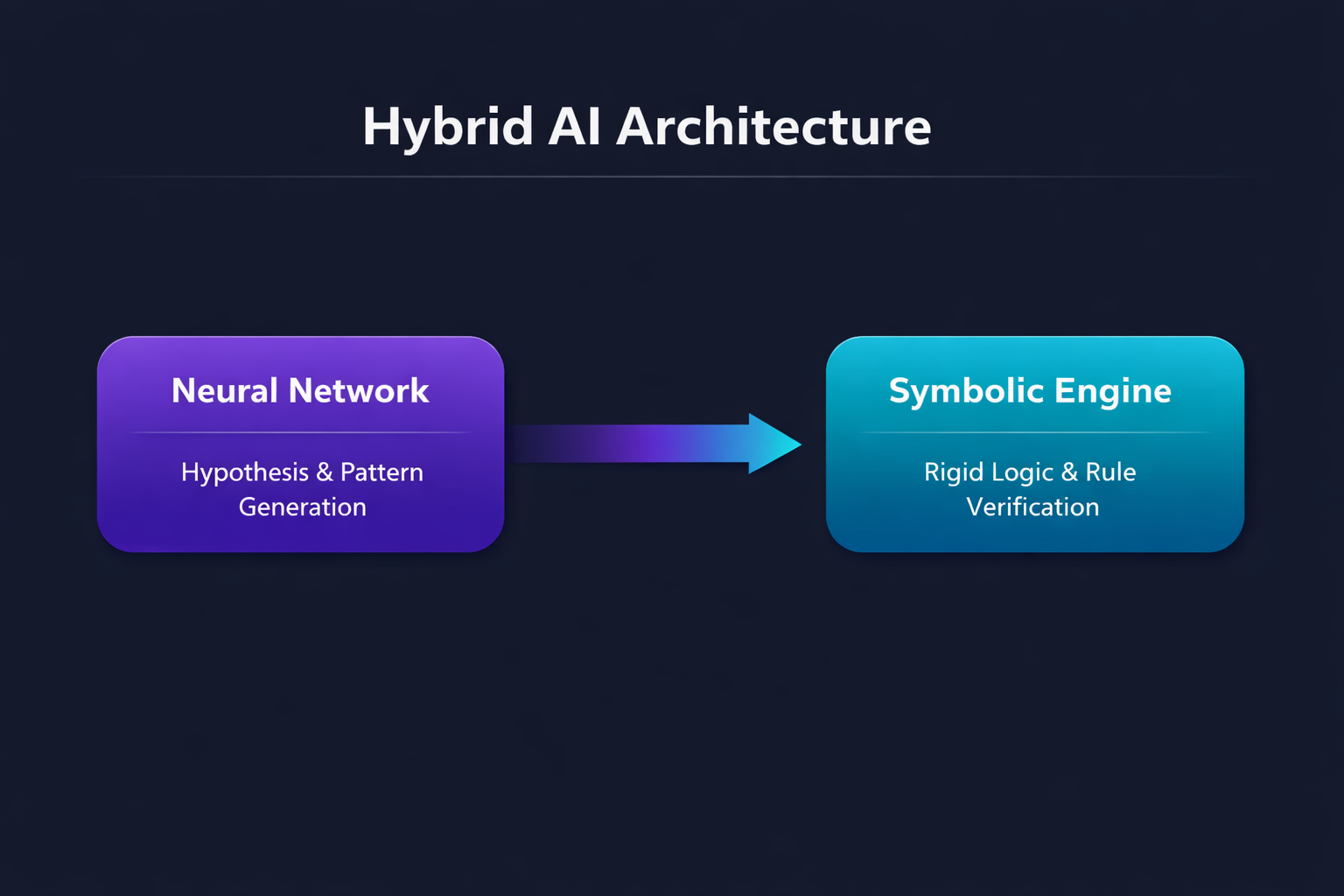
View ASCII source
┌─────────────────────────────────────────────────────────────┐
│                 Hybrid AI Architecture                      │
│                                                             │
│  ┌───────────────────────┐       ┌───────────────────────┐  │
│  │    Neural Network     │       │    Symbolic Engine    │  │
│  │                       │ ────► │                       │  │
│  │ (Hypothesis & Pattern │       │ (Rigid Logic & Rule   │  │
│  │      Generation)      │       │     Verification)     │  │
│  └───────────────────────┘       └───────────────────────┘  │
└─────────────────────────────────────────────────────────────┘
Furthermore, academic institutions and tech companies will collaborate to establish formal protocols for AI-assisted peer review. Organizations like the Clay Mathematics Institute, IEEE, and ACM will publish clear guidelines defining what constitutes a valid machine-assisted proof, including mandatory requirements for training set disclosure, execution reproducibility, and human-readable explanations.
In enterprise technology, these advancements will trickle down to software engineering tools, automated legal document analysis, and complex system automation. We will see the emergence of specialized verification agent frameworks designed specifically to test, stress-test, and audit the output of primary operational AI models, introducing a system of checks and balances within corporate software suites.
Conclusion
OpenAI’s foray into the Millennium Prize Problems was meant to showcase the ultimate potential of machine intelligence. Instead, it exposed the complex friction point where advanced statistical machine learning meets absolute, unforgiving logic. While the company's multi-agent reasoning models achieved remarkable technical feats, the surrounding controversy underscored a fundamental truth: execution without transparency, provenance, and human-verifiable insight is not enough.
As artificial intelligence moves from generating conversational text to automating complex logical workflows in the real world, the lessons of this mathematical debate become essential. Success in the next generation of AI development will not be measured merely by brute-force compute or high benchmark scores. It will belong to those who build transparent, auditable, and reliable systems that combine the creative power of neural networks with the uncompromising precision of deterministic logic.
Build With Developers of Chicago
If this kind of AI capability matters to your product, you need a team that can actually ship it. Developers of Chicago helps startups and enterprises design, build, and deploy AI-powered software — from custom integrations to full-scale automation systems.
- AI Integration & Automation — Explore our AI services
- Custom Software Development — See our services
- Mobile App Development — Build with us
- Start a Project — Book a call
Based in Chicago. Building for clients everywhere.