Developers of Chicago Engineering Blog
Grok Bot: The First Real AI Agent Operating System
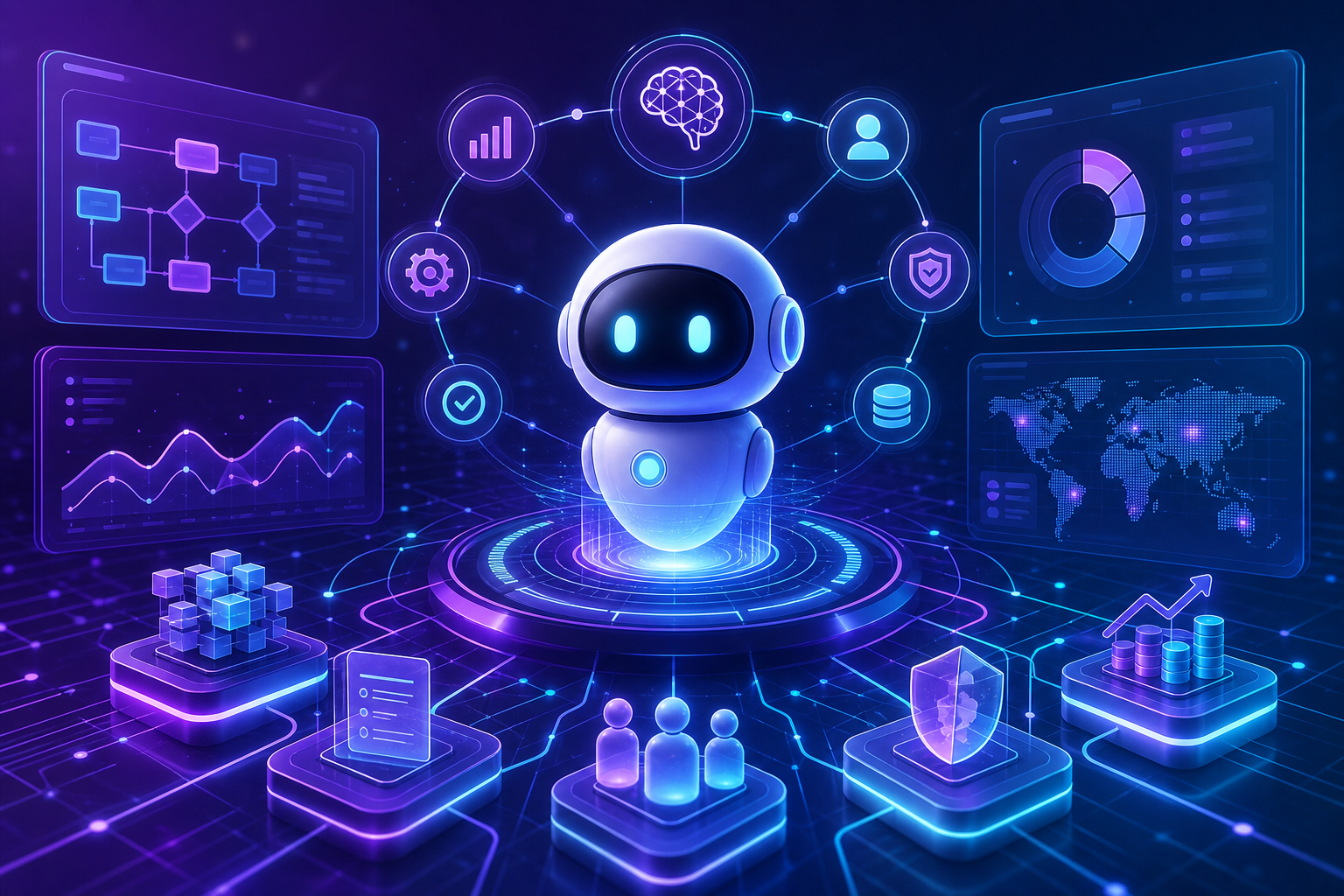
The software industry is undergoing a monumental shift: the transition from conversational chatbot interfaces to persistent, autonomous AI Agent Operating Systems (OS). For the past several years, generative AI and machine learning models have operated primarily in reactive, stateless sessions. You type a prompt, receive a response, and the context resets or degrades over time. While impressive, this paradigm requires constant human steering, manual context setting, and fragmented tool usage.
Enter the era of the AI Agent OS, exemplified by the breakthrough architecture of Grok Bot. Rather than acting as a simple text box that forgets your instructions when you close the tab, an AI Agent OS serves as a long-running execution environment. It combines persistent memory, native sandboxed code execution, autonomous multi-agent orchestration, and system-level API access. Grok Bot represents a fundamentally new way for developers and enterprises to think about software automation: transforming artificial intelligence from a passive advisory tool into an active, always-on digital teammate.
Understanding how to architect, deploy, and scale persistent agent systems is no longer just an experimental curiosity—it is becoming a core competitive advantage for modern digital businesses. In this comprehensive guide, we break down what Grok Bot's AI Agent OS architecture entails, how it functions under the hood, its industry-wide impact, and actionable strategies for building real-world enterprise agent workflows.
What Happened: The Evolution into a Real AI Agent OS
The release and structural framework surrounding Grok Bot signals a definitive break from traditional LLM chat interfaces. Historically, autonomous agent experiments like AutoGPT or early BabyAGI demonstrated the potential of looping prompts to solve tasks, but they suffered from high execution failure rates, catastrophic context loss, runaway API costs, and a lack of deterministic state management. Grok Bot addresses these foundational flaws by re-architecting the agent runtime from the ground up as an operating system.
At its core, Grok Bot introduces a persistent runtime layer that manages system state, thread memory, file access, and background tool execution without requiring direct user intervention at every step. Built upon high-throughput processing capabilities and deep tool-use integration, Grok Bot operates continuously across sessions. When assigned an objective, it breaks down complex instructions into deterministic sub-tasks, spins up specialized worker instances, monitors execution progress, handles runtime errors, and saves intermediate states to persistent storage.
This advancement bridges the gap between raw statistical text generation and reliable software engineering. By providing an environment where agents can execute code inside isolated sandboxes, browse the live web, write and read local filesystems, and interact directly with third-party software via API bridges, Grok Bot effectively acts as an operating system designed specifically for non-deterministic model runtimes.
Key Details: Technical Specifics, Scale, and Architecture
To understand why Grok Bot represents such a leap forward, we must look at the key technical pillars that define an AI Agent OS: persistent state management, sandboxed execution runtime, native tool integration, and multi-agent coordination frameworks.
1. Persistent State and Memory Architecture
Unlike standard LLM endpoints that rely solely on an ephemeral context window, Grok Bot utilizes a multi-tiered memory architecture:
- Episodic Memory: Captures context and exact execution steps within an active task thread using key-value state stores.
- Semantic Memory: Leverages vector database retrievals (RAG) to pull historical context, system guidelines, and documentation across weeks or months of operations.
- Stateful Workspaces: Persists file systems, environment variables, and shell states so an agent can pause execution, yield execution cycles, and resume exactly where it left off without re-processing full token histories.
2. Sandboxed Compute Runtimes
Security and execution control are paramount when granting AI models system access. Grok Bot operates within isolated micro-containers (Docker/WebAssembly micro-sandboxes). Within these sandboxes, agents can:
- Write, compile, and execute Python, JavaScript, Shell, and SQL scripts.
- Run local terminal commands to install dependencies and parse complex datasets.
- Render visual interfaces, inspect UI elements, and execute browser-based automation tasks deterministically.
3. Multi-Agent Orchestration Protocols
Rather than relying on a single, overburdened context window to handle every step of an enterprise project, Grok Bot implements a manager-worker topology. A central orchestrator agent receives human goals, designs a execution roadmap, and spawns sub-agents provisioned with hyper-focused system prompts, minimal necessary tools, and dedicated memory scopes. Sub-agents communicate back to the primary orchestrator using structured JSON payloads, drastically reducing hallucination rates and preventing context drift.
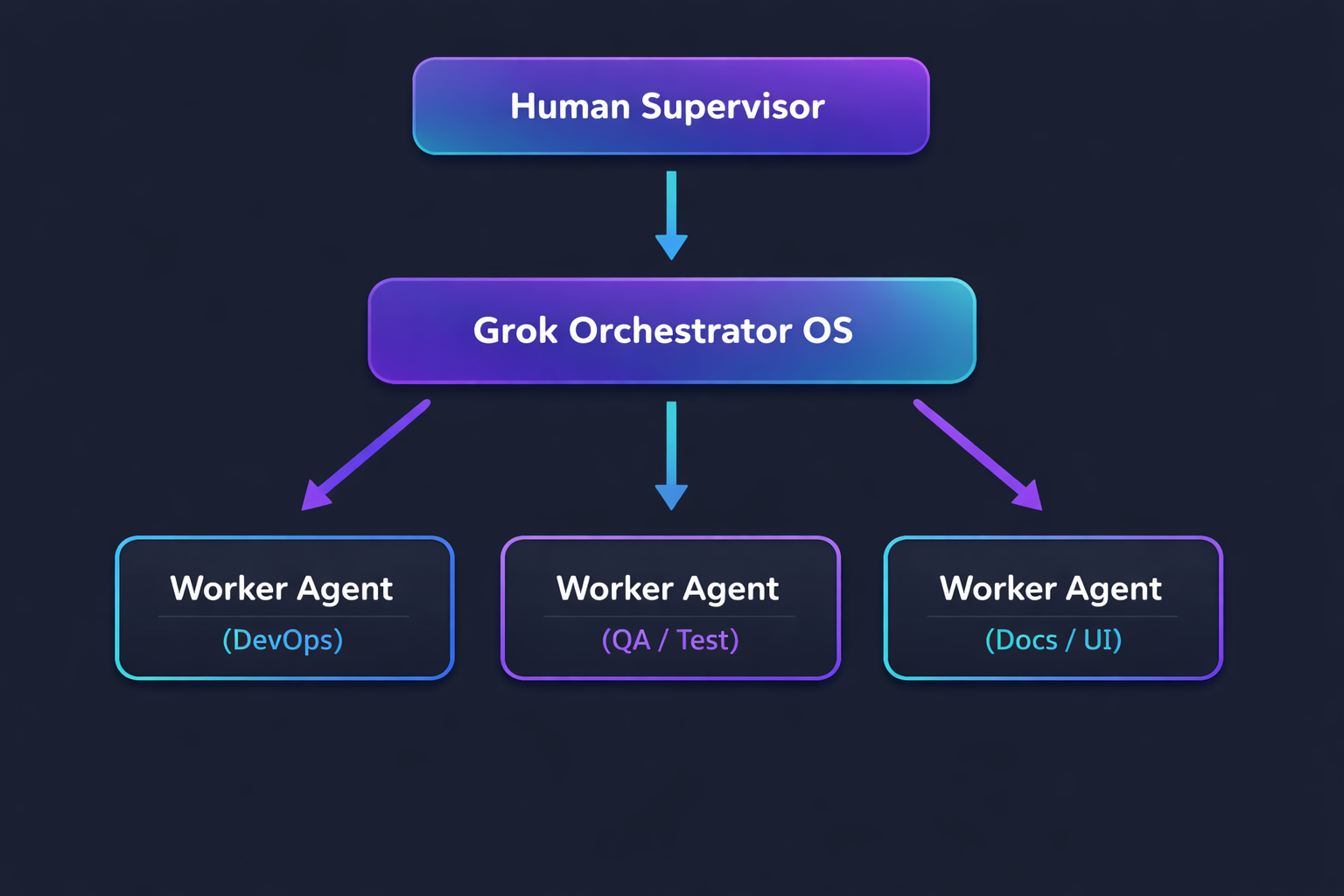
View ASCII source
                  +------------------------+
                  |    Human Supervisor    |
                  +-----------+------------+
                              |
                              v
                  +------------------------+
                  |  Grok Orchestrator OS  |
                  +-----------+------------+
                              |
       +----------------------+----------------------+
       |                      |                      |
       v                      v                      v
+--------------+       +--------------+       +--------------+
| Worker Agent |       | Worker Agent |       | Worker Agent |
|  (DevOps)    |       |  (QA / Test) |       |  (Docs / UI) |
+--------------+       +--------------+       +--------------+
Impact on the AI Industry: A Paradigm Shift for Enterprise Software
The arrival of a functional AI Agent OS like Grok Bot disrupts multiple sectors within the technology ecosystem, shifting the market dynamics away from basic wrapper applications and toward deep platform integration.
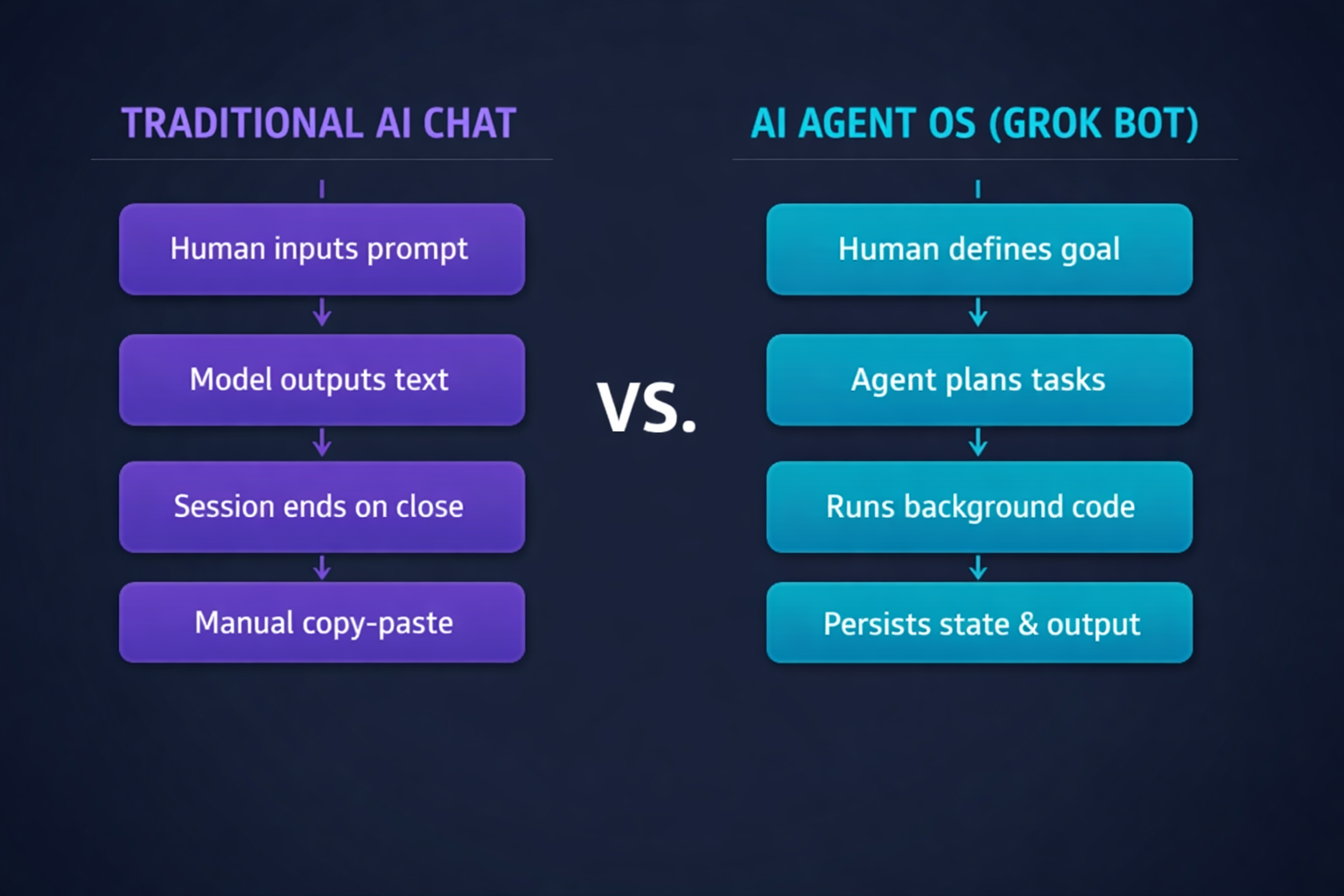
View ASCII source
TRADITIONAL AI CHAT                   AI AGENT OS (GROK BOT)
+-------------------------+           +-------------------------+
| Human inputs prompt     |           | Human defines goal      |
| Model outputs text      |   VS.     | Agent plans tasks       |
| Session ends on close   |           | Runs background code    |
| Manual copy-paste       |           | Persists state & output |
+-------------------------+           +-------------------------+
The Collapse of the "Wrapper" Ecosystem
For years, hundreds of startups built micro-businesses around thin software wrappers over LLM APIs—offering specialized services like single-purpose email draft generators, isolated code summarizers, or basic CSV parsers. An AI Agent OS makes these isolated tools largely obsolete. When an enterprise platform can orchestrate code execution, tool call chains, and file persistence autonomously, single-purpose software tools are quickly replaced by dynamic, multi-agent workflows running on a unified OS architecture.
Shift in SaaS Licensing and Token Economics
The industry is moving rapidly from seat-based pricing (per user per month) to outcome-based or compute-aligned pricing models. Businesses are evaluating AI not by how many employee licenses they buy, but by the work throughput achieved per GPU node or token budget. Grok Bot highlights the importance of cost-effective compute optimization: by delegating small, focused tasks to smaller, highly optimized models while reserving heavy reasoning models for orchestrator nodes, companies can reduce operational costs while dramatically increasing throughput.
Increased Competition Among Big Tech Infrastructure
Grok Bot’s OS-level approach forces major competitors—including OpenAI (Custom GPTs/Assistants API), Anthropic (Claude Computer Use), Microsoft (Copilot Studio), and Google (Gemini Enterprise)—to accelerate their runtime execution capabilities. The race is no longer just about who has the highest benchmark score on MMLU or HumanEval; it is about who provides the most secure, reliable, persistent, and low-latency agent execution environment for mission-critical enterprise systems.
What Developers and Businesses Should Know: Actionable Takeaways
Transitioning to an AI Agent OS architecture requires new architectural patterns, security controls, and design principles. Whether you are building internal custom automations or commercial software products, here are the key operational insights you need to know.
1. Design for Human-in-the-Loop (HITL) Validation
Autonomous agents operating in persistent environments must be given bounded authority. While basic tasks (such as gathering data or running unit tests) can run autonomously, sensitive actions—such as committing production code, sending external emails, or executing financial transactions—must require cryptographic or explicit human approval. Build programmatic "interrupt points" into your workflow orchestrations where agents halt execution state until a human operator signs off via Webhook, Slack notification, or dashboard button.
2. Implement Zero-Trust Security Protocols
Granting an AI system code execution capabilities introduces risk if not properly managed. Developers must enforce strict zero-trust parameters:
- Network Isolation: Limit agent outbound network connectivity strictly to whitelisted domain endpoints required for the task.
- Short-Lived Ephemeral Credentials: Never hardcode master API keys into agent workspaces. Use identity management services to issue temporary, scoped tokens for specific task executions.
- Prompt Injection Safeguards: Sanitize all external inputs—web browser text, external API payloads, uploaded files—before passing them into orchestrator contexts to prevent prompt injection hijacking.
3. Top 8 End-to-End Enterprise Agent Workflows
To illustrate the versatility of an AI Agent OS like Grok Bot, here are eight operational workflows businesses can build today:
- Autonomous DevOps Triage: Detect application errors via monitoring tools (e.g., Sentry), isolate stack traces, spin up a sandboxed codebase, run reproduction scripts, and draft pull requests with proposed bug fixes.
- Continuous Competitive Intelligence: Schedule persistent web scraper agents to monitor competitor pricing changes, product documentation updates, and press releases, automatically synthesizing weekly executive summaries in Notion or Slack.
- Automated QA and End-to-End Testing: Deploy browser-agent clusters that write their own Playwright/Cypress scripts, navigate dynamic web apps, identify UI visual regressions, and report step-by-step reproduction logs.
- Inbound Lead Enrichment & Qualification: Parse inbound sales queries, query clearbit/LinkedIn APIs, assess fit based on internal ideal customer profiles, update CRM records, and generate personalized follow-up sequences.
- Multi-Source Code Refactoring & Security Audit: Scan legacy codebases for deprecated dependencies or security vulnerabilities, execute automated refactoring across hundreds of files simultaneously, and run full test suites to verify functionality.
- Dynamic Customer Support Escalation: Handle multi-step support tickets by querying internal database schemas via SQL, validating customer identities, issue refunds via payment gateways within strict budget limits, and escalating anomalies to human agents.
- Financial Reconciliation & Invoicing: Pull raw transaction logs, parse unstructured PDF receipts using OCR, reconcile items against internal accounting databases (QuickBooks/Xero), and flag discrepancies for auditing teams.
- Automated Localization and Content Adaptation: Parse raw software string files, translate content accounting for target region idioms, compile regional assets, and preview rendered layouts to catch layout overflows automatically.
Future Outlook: Where AI Agent Operating Systems Are Headed
Over the next 6 to 12 months, the landscape of AI Agent OS technology will evolve rapidly from early-adopter framework implementations to standard enterprise infrastructure.

View ASCII source
       PRESENT                          NEAR FUTURE (6-12 MONTHS)
+-----------------------+              +-----------------------+
| Cloud-bound workloads |              | Local/Edge Execution  |
| Text/JSON APIs        |    ====>     | Multimodal Native     |
| Custom Orchestrators  |              | Standard Protocols    |
| Custom Sandboxes      |              | Deterministic Engines |
+-----------------------+              +-----------------------+
1. Standardization of Agent Interoperability Protocols
We will see open-standard communication protocols emerge—similar to HTTP/REST or gRPC—specifically designed for agent-to-agent negotiation. These standards will govern how agents from different organizations authenticate, exchange structured context, delegate tasks, and negotiate compute budgets autonomously.
2. Local-First & Edge Agent Execution
While cloud computing will continue to dominate heavy model inference, advances in model quantization (4-bit/2-bit optimization) and dedicated local NPU acceleration will enable localized execution of AI Agent OS runtimes. Local agents will operate securely on desktop computers and enterprise hardware without sending sensitive file content over the public cloud.
3. Self-Healing Software Ecosystems
As AI Agent OS environments become embedded in software development pipelines, software engineering will shift toward self-healing architectures. Microservices will run autonomous background agents that monitor live telemetry, automatically fix minor run-time bugs, write patch tests, and push hotfixes in real-time, drastically minimizing downtime.
Conclusion
The shift from simple, conversational text models to a persistent AI Agent OS like Grok Bot represents a crucial milestone in artificial intelligence. By unifying long-term state management, secure code execution environments, and sophisticated multi-agent orchestration, an AI Agent OS fundamentally changes how software is built, maintained, and operated.
For modern enterprises and engineering leaders, the mandate is clear: moving beyond basic prompt engineering toward building robust, scalable, and secure agent-driven systems. Organizations that master persistent agent workflows today will achieve unparalleled operating leverage, execution speed, and software performance in the years ahead.
Build With Developers of Chicago
If this kind of AI capability matters to your product, you need a team that can actually ship it. Developers of Chicago helps startups and enterprises design, build, and deploy AI-powered software — from custom integrations to full-scale automation systems.
- AI Integration & Automation — Explore our AI services
- Custom Software Development — See our services
- Mobile App Development — Build with us
- Start a Project — Book a call
Based in Chicago. Building for clients everywhere.