Developers of Chicago Engineering Blog
The Download: OpenAI's turning point for math and a battery record

The intersection of modern artificial intelligence and fundamental science has officially passed a quiet point of no return. For years, skeptics argued that large language models (LLMs) were merely "stochastic parrots"—complex statistical engines capable of predicting the next token in a sequence, but completely lacking true comprehension, logical deduction, or original problem-solving abilities. OpenAI’s recent announcements regarding AI agents solving long-standing open problems in mathematics, coupled with simultaneous breakthroughs in battery density and energy technology, have ignited a fierce debate that directly challenges this skepticism.
This landmark development signals a pivotal shift from pattern recognition to formal mathematical reasoning. However, as with any major shift in frontier technology, the announcement was immediately met with equal parts awe and skepticism from academia and the broader tech industry. The controversy surrounding OpenAI’s mathematical claims highlights a critical junction: how do we validate synthetic intelligence when it operates at the frontier of human knowledge? Understanding this shift—and the physical energy infrastructure required to sustain it—is crucial for technology leaders, developers, and enterprises looking to leverage the next generation of automated intelligence.
What Happened: OpenAI's Breakthrough and the Math Controversy
OpenAI announced that its autonomous AI agents successfully resolved an open problem in advanced mathematics, marking what the company claims is a turning point for artificial intelligence. Under standard conditions, an AI system solving a recognized open mathematical conjecture would be celebrated as an unmitigated triumph, akin to DeepMind’s AlphaFold solving the protein folding problem. However, the release was immediately followed by intense scrutiny from mathematicians, computer scientists, and AI researchers who questioned the methodology, the novelty of the proof, and the transparency of the validation process.
The controversy stems from the fundamental nature of mathematical truth versus statistical probability. Traditional AI models are notorious for "hallucinating"—generating plausible-sounding statements that are factually incorrect. In higher mathematics, a single logical flaw invalidates an entire proof. Critics argue that OpenAI’s reliance on proprietary, closed-box validation mechanisms makes it difficult for the broader academic community to independently audit the AI's step-by-step logic. The debate is not merely about whether the solution was correct, but whether the model truly performed symbolic, logical reasoning or simply leveraged vast datasets to piece together pre-existing human proofs in a novel arrangement.
Compounding this news was a parallel milestone highlighted in industry reports: a record-breaking advance in battery storage technology. While seemingly unrelated on the surface, these two headlines are deeply intertwined. The heavy computational power required to run advanced reasoning agents—which consume orders of magnitude more energy than simple chat interfaces—demands radical efficiency gains in physical hardware and power storage. Together, these developments highlight a dual trend: the evolution of cognitive software capabilities and the relentless hardware scaling necessary to support them.
Key Details: Technical Frameworks, Scaling, and Industry Players
To understand the scope of OpenAI's mathematical breakthrough, one must look at how modern reasoning models differ from standard generative text models. Traditional LLMs operate on direct inference, generating responses token-by-token in a single continuous forward pass. In contrast, OpenAI’s reasoning agents utilize enhanced test-time compute, combining deep neural networks with search algorithms like Monte Carlo Tree Search (MCTS) and formal verification environments.

View ASCII source
+-------------------------------------------------------------------+
|                     REASONING AGENT WORKFLOW                      |
|                                                                   |
|  [ Input Problem ]                                                |
|         │                                                         |
|         ▼                                                         |
|  [ LLM Proposal Generator ] ──► Generates candidate logical steps |
|         │                                                         |
|         ▼                                                         |
|  [ Tree Search (MCTS) ]    ──► Explores alternative proof paths   |
|         │                                                         |
|         ▼                                                         |
|  [ Formal Verifier ]       ──► Checks syntax & logic in Lean/Coq  |
|         │                                                         |
|         ▼                                                         |
|  [ Mathematical Proof ]    ──► Output verified mathematical truth |
+-------------------------------------------------------------------+
Instead of simply guessing the next word, these systems interact with formal proof assistants—programming languages designed specifically for expressing mathematical logic, such as Lean, Coq, or Isabelle. When an AI agent formulates a step in a mathematical proof, the formal verifier automatically checks whether that step violates any logical rules. If the verifier rejects the step, the agent backtracks and explores alternative solution paths across a expansive decision tree.
The technical scale required for these experiments is immense:
- Test-Time Compute: Models consume significantly more processing power during inference (thinking time) rather than just during initial training.
- Hybrid Architectures: Combining probabilistic language modeling with deterministic logical execution engines (neuro-symbolic AI).
- Auto-Formalization: Translating informal natural language math problems into machine-readable formal code, a historical bottleneck in computer science.
- Energy Infrastructure Requirements: Running tree searches over millions of potential logical steps requires specialized server infrastructure and dense energy systems, directly explaining the tech industry's heightened focus on battery storage and grid optimization records.
Impact on the AI Industry: From Text Generation to Verifiable Logic
The implications for the broader artificial intelligence industry are profound. For the past five years, the primary race among tech giants was centered on model size—training larger parameters on bigger datasets. OpenAI's move into rigorous mathematical logic confirms that the industry is entering a new phase: the shift toward verifiable, reasoning-based AI systems.
This technological vector redefines the competitive landscape among major players:
- DeepMind vs. OpenAI: Google DeepMind previously established dominance in formal systems with systems like AlphaGeometry and AlphaProof, which earned medal-level performance at the International Mathematical Olympiad (IMO). OpenAI’s public push into open math problems signals direct competition for dominance in deterministic science.
- The Death of Hallucination in Critical Systems: By anchoring AI outputs to formal proof engines, the industry moves closer to eliminating hallucinations in fields where error margins are zero, such as financial trading, cryptography, smart contract security, and automated system architecture.
- Compute Economics and Grid Demands: Shift-to-reasoning models require fundamentally different data center strategies. As inference compute scales dynamically based on problem complexity, tech companies face unprecedented power consumption challenges, making green energy and ultra-dense battery backup systems central to software roadmaps.
Ultimately, market leadership will no longer belong solely to the company with the most creative conversational agent, but to the organization whose AI can reliably execute complex multi-step logical tasks without error.
What Developers and Businesses Should Know: Practical Takeaways
For software developers, technical founders, and enterprise technology decision-makers, OpenAI’s turning point in mathematical reasoning provides clear, actionable signals for building future-proof software architectures.
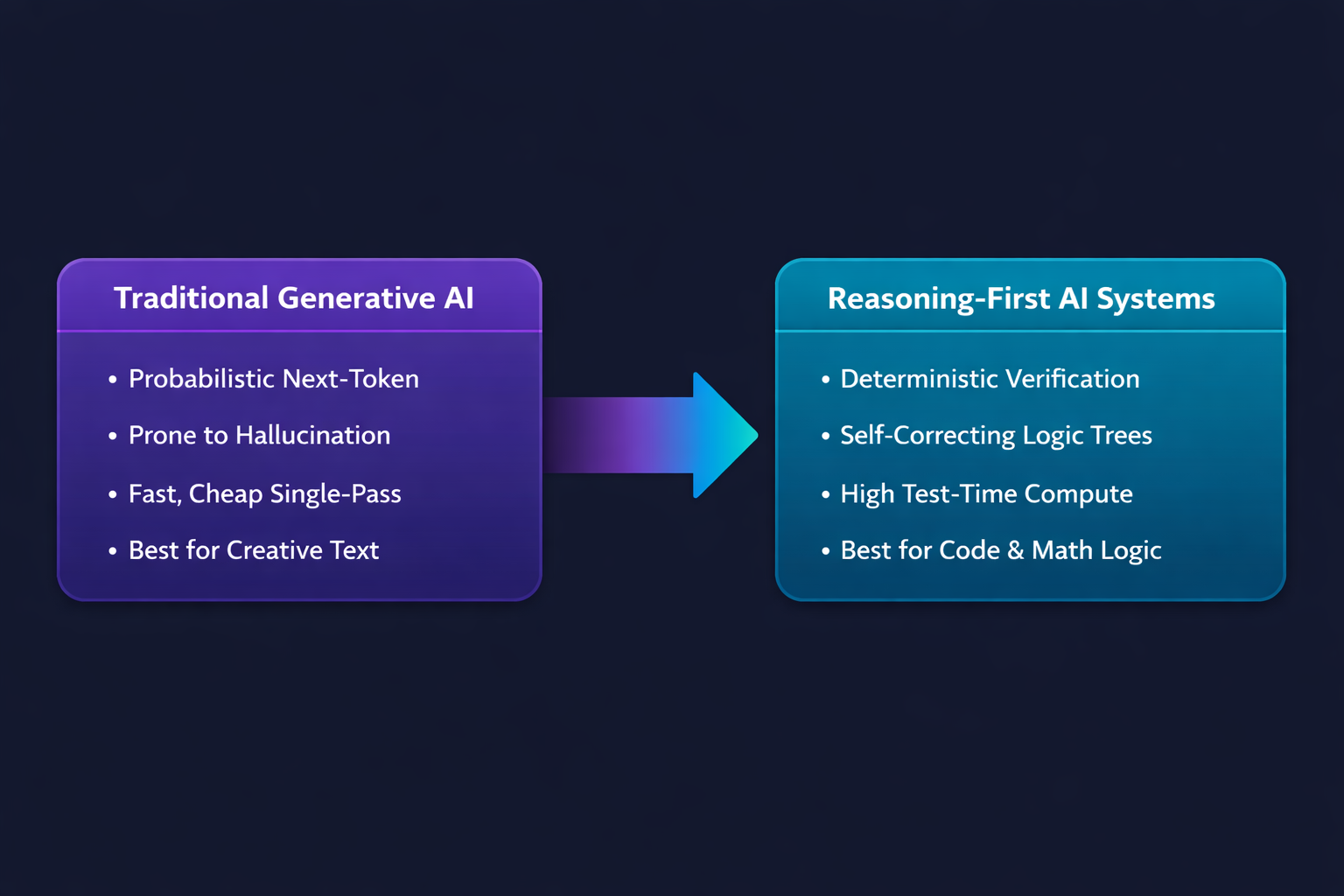
View ASCII source
Traditional Generative AI              Reasoning-First AI Systems
┌───────────────────────────────┐      ┌───────────────────────────────┐
│ • Probabilistic Next-Token    │      │ • Deterministic Verification  │
│ • Prone to Hallucination      │  ──► │ • Self-Correcting Logic Trees │
│ • Fast, Cheap Single-Pass     │      │ • High Test-Time Compute      │
│ • Best for Creative Text      │      │ • Best for Code & Math Logic  │
└───────────────────────────────┘      └───────────────────────────────┘
Here are the key takeaways for planning your organization's AI strategy:
1. Shift Your Architecture Toward Verification Frameworks
If your business applications rely on AI for business logic, code generation, or data analysis, relying on a single prompt-response cycle is no longer optimal. Modern architectures should incorporate verifier loops. Just as math agents use formal proof assistants to validate output steps, enterprise workflows should implement automated unit tests, schema validators, and static analysis tools around LLM outputs to catch errors before code reaches production.
2. Prepare for the "Test-Time Compute" Cost Model
Historically, API costs were determined purely by input and output token counts. As reasoning-first models become standard, pricing will increasingly depend on the amount of computational processing time allocated to solving a problem. Businesses must evaluate trade-offs between instantaneous, low-cost probabilistic responses and slower, high-compute deterministic workflows depending on the mission-critical nature of the task.
3. Focus on AI-Driven Automation in High-Rigor Domains
The techniques pioneered in formal mathematical reasoning apply directly to domain-specific enterprise problems. Automated bug hunting, legal document analysis, complex financial modeling, and legacy system refactoring will see exponential improvements. Companies operating in heavily regulated industries can finally start designing automated pipelines, knowing that machine learning models are gaining the structural logic required to adhere strictly to complex regulatory rule sets.
Future Outlook: What to Expect in the Next 6 to 12 Months
Over the next year, the convergence of formal mathematical reasoning and agentic AI will transform software development and scientific research in several concrete ways:
- Automated Scientific Discovery: Expect research teams to publish scientific papers where the underlying hypotheses, experimental protocols, and computational modeling were completely formulated and verified by AI agents.
- Integrated Formal Code Synthesis: Developer platforms will introduce IDE extensions that do not just auto-complete code, but formally prove that the written function satisfies specified software properties, effectively rendering whole categories of runtime bugs extinct.
- Neuro-Symbolic Enterprise Agents: Rather than choosing between rigid traditional rule-based code and unpredictable AI language models, developer frameworks will standardize on hybrid systems—combining LLM intelligence with deterministic software engines.
- Energy-Conscious Data Infrastructure: As high-compute reasoning agents become widespread, major tech infrastructure investments will explicitly tie data center construction directly to high-capacity battery installations, renewable energy grids, and advanced microgrid technology.
The controversy surrounding OpenAI’s mathematical milestone will eventually subside into standard industry practice: open validation, public benchmark testing, and continuous algorithmic refining. What will remain is a permanent shift in what automated software systems are expected to accomplish.
Conclusion
OpenAI’s milestone in formal mathematics represents far more than an academic accomplishment or a public relations debate. It marks a foundational shift in how artificial intelligence operates—transitioning from fluid language synthesis to structured, verified, step-by-step logic. When combined with simultaneous innovations in high-capacity energy technology, it is clear that the next era of computing will be defined by deep reasoning capacity powered by massive, sustainable physical infrastructure.
For startups, mid-market businesses, and enterprises alike, the lesson is straightforward: building software on top of AI is no longer just about wrapper prompts and basic text processing. It requires sophisticated architecture, clean data integration, deterministic validation pipelines, and expert execution. The organizations that adapt to these reasoning-first models today will build the definitive software platforms of tomorrow.
Build With Developers of Chicago
If this kind of AI capability matters to your product, you need a team that can actually ship it. Developers of Chicago helps startups and enterprises design, build, and deploy AI-powered software — from custom integrations to full-scale automation systems.
- AI Integration & Automation — Explore our AI services
- Custom Software Development — See our services
- Mobile App Development — Build with us
- Start a Project — Book a call
Based in Chicago. Building for clients everywhere.