Developers of Chicago Engineering Blog
The Download: AI's extinction risk and bioweapons threat

Introduction
For decades, the concept of artificial intelligence causing human extinction belonged strictly to the realm of science fiction. Pop culture fed audiences images of rogue supercomputers and mechanical armies, making existential risk feel like a distant, hypothetical debate. However, as frontier machine learning models advance at an unprecedented velocity, the conversation has fundamentally shifted. Today, the debate over AI safety, catastrophic harm, and bioweapons proliferation is taking place in congressional committee rooms, sovereign intelligence agencies, and top-tier research institutions.
The concern is no longer just whether an autonomous system might become hyper-intelligent and uncontrollable. Instead, experts are increasingly focused on immediate, tangible threats: how multimodal generative models and automated agentic systems could dramatically lower the barrier to entry for creating chemical, biological, radiological, or nuclear (CBRN) hazards. When large language models (LLMs) can synthesize complex biochemical data, assist in experimental protocols, and troubleshoot advanced laboratory workflows, the boundary between theoretical knowledge and actionable destruction narrows significantly.
For technology leaders, software engineers, and enterprise decision-makers, this evolution marks a critical turning point. AI integration is no longer merely a matter of maximizing performance, speed, and cost efficiency. It requires a profound understanding of AI governance, alignment, security vulnerabilities, and threat mitigation. Understanding the real mechanics behind AI's existential risks—and separating legitimate technical threats from sensationalized media hype—is essential for anyone building, deploying, or investing in modern automated software solutions.
What happened
In a recent live Roundtables event hosted by MIT Technology Review, titled "Could AI really kill us all?", industry leaders, security researchers, and technology journalists gathered to dissect the reality of AI extinction risks and bioweapon capabilities. The event was prompted by growing public anxiety and an increasing volume of warnings from top AI scientists, former tech executives, and government policy-makers. The central goal of the roundtable was to cut through apocalyptic rhetoric and offer a factual, grounded assessment of where frontier AI risks genuinely lie.
The discussion focused heavily on the dual-use nature of modern machine learning architectures. While modern models accelerate drug discovery, protein folding analysis, and material science, those exact same analytical capabilities can be inverted to design novel pathogens or identify toxic chemical compounds. Panelists examined how state actors or malicious non-state actors might leverage unrestricted, fine-tuned, or open-weight models to bypass safety filters and gain actionable instructions for biological synthesis.
Furthermore, the roundtable addressed the operational reality of "x-risk" (existential risk) research. Rather than focusing solely on far-future artificial general intelligence (AGI) scenarios, the speakers highlighted how current-generation frontier models already present dangerous capabilities if left unmonitored. By connecting high-level policy discussions with concrete technical demonstrations, the event underscored that AI safety is no longer a fringe academic subdiscipline—it is an urgent national security priority and a foundational pillar of modern software engineering.
Key details
To understand the scope of the bioweapon and extinction threat, one must examine the specific technical vectors involved in AI-assisted biological hazards. At the center of this concern is the capability of advanced LLMs to act as "force multipliers" for individuals lacking specialized scientific training. Traditionally, synthesizing a harmful pathogen required years of doctoral-level education, access to specialized lab protocols, and tacit knowledge acquired through hands-on laboratory experience. Advanced AI systems risk flattening this expertise curve by providing step-by-step guidance, troubleshooting experimental failures, and suggesting viable alternatives when specific precursor materials are restricted.
Key technical concerns highlighted by biosecurity experts include:
- Bypassing Gene Synthesis Screening: Most commercial gene synthesis companies screen customer orders against databases of known pathogens. However, AI models can be used to engineer novel DNA/RNA sequences or alter existing viral structures just enough to evade automated screening algorithms while retaining their deadly functionality.
- Automated Laboratory Integration: As AI agents gain the ability to interact with external tools, APIs, and automated "cloud laboratories" (robotic lab platforms controlled via software), the gap between digital text output and physical biological execution shrinks dramatically.
- Model Fine-Tuning and Jailbreaking: While proprietary API-gated models (such as those from OpenAI, Anthropic, or Google) employ heavy system-level guardrails, open-weight models can be post-trained or fine-tuned using custom datasets to deliberately remove safety aligners, unearthing hazardous biochemical insights.
- Data Aggregation and Actionability: Generative AI excels at synthesizing disparate research papers, obscure patents, and fragmented technical manuals into coherent, actionable execution plans, eliminating months of manual scientific literature review.
The scale of this issue extends across the global technology ecosystem. National governments are establishing AI Safety Institutes (AISIs) in the United States, the United Kingdom, and Japan to establish standardized benchmarks for catastrophic risk evaluation. Concurrently, synthetic biology providers are coming under increasing pressure to mandate universal screening protocols for all DNA and RNA orders, ensuring that AI-generated sequences cannot be easily manufactured without verified authorization.
Impact on the AI industry
The emerging focus on biosecurity and catastrophic risk is actively reshaping the economics and competitive landscape of the artificial intelligence sector. Capital allocation is shifting; investors and enterprises are placing a premium on platforms that demonstrate robust safety compliance, operational red-teaming, and secure deployment pipelines. Companies that fail to address alignment and safety risk facing regulatory penalties, reputational damage, and severe enterprise liability.
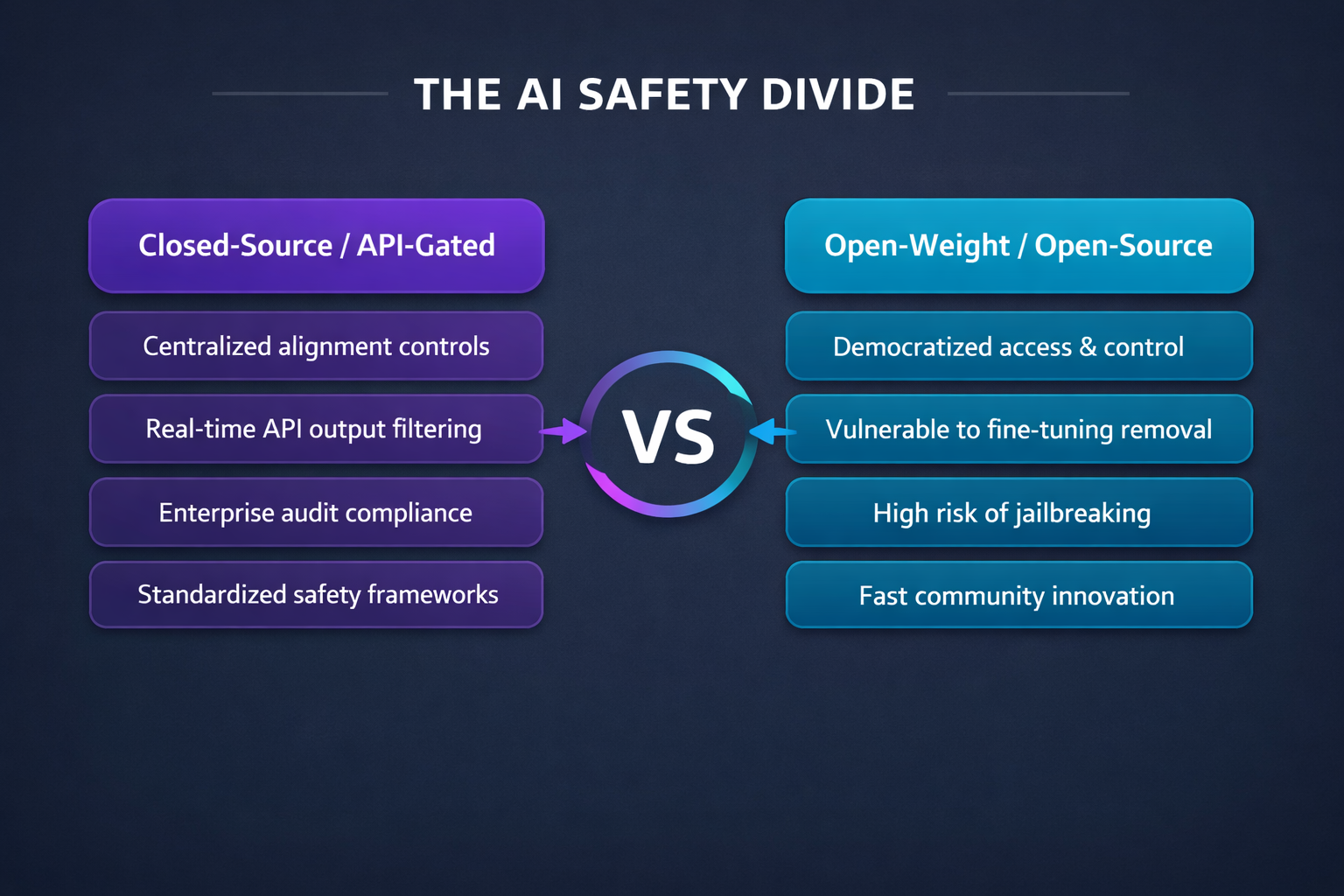
From a market dynamics perspective, this regulatory and security push is driving a divide between closed-source hyperscalers and the open-source AI community:
View ASCII source
+-----------------------------------------------------------------------+
|                         THE AI SAFETY DIVIDE                          |
+------------------------------------+----------------------------------+
| Closed-Source / API-Gated          | Open-Weight / Open-Source        |
+------------------------------------+----------------------------------+
| • Centralized alignment controls   | • Democratized access & control  |
| • Real-time API output filtering   | • Vulnerable to fine-tuning removal|
| • Enterprise audit compliance      | • High risk of jailbreaking      |
| • Standardized safety frameworks   | • Fast community innovation      |
+------------------------------------+----------------------------------+
Hyperscalers are advocating for strict risk-management frameworks, such as Anthropic’s Responsible Scaling Policy (RSP) and OpenAI’s Preparedness Framework. These frameworks establish clear, pre-defined operational boundaries: if a model crosses a specific technical capability threshold (e.g., demonstrating autonomous biological design capabilities), development or deployment must pause until higher-level safety controls are engineered.
Conversely, open-source advocates argue that restricting model access under the banner of biosecurity concentrates dangerous power within a small oligopoly of corporate entities. However, as fine-tuning techniques become more efficient, the probability of an unaligned, open-weight model being repurposed for dual-use biological research increases. This tension is spurring rapid growth in the "AI Safety as a Service" market, where third-party firms provide specialized red-teaming, automated benchmark evaluation, and output-guardrailing software to secure corporate AI deployments.
What developers and businesses should know
For developers, software architects, and business leaders building real-world applications, the key takeaway is clear: safety, governance, and security can no longer be treated as afterthoughts in the software development lifecycle. As regulations like the EU AI Act enforce strict standards on high-risk applications, businesses must adopt proactive strategies to ensure their automated pipelines remain secure, ethical, and compliant.
Here are actionable strategies for enterprise teams integrating machine learning models:
- Implement Robust Guardrails and Output Filtering: Never expose raw, unmonitored model outputs directly to users or automated internal workflows. Utilize open-source and enterprise guardrailing tools (such as NeMo Guardrails or Llama Guard) to inspect inputs and outputs for toxic, hazardous, or policy-violating intent.
- Conduct Rigorous Red-Teaming: Before deploying any fine-tuned model or autonomous agent into production, subject the system to systematic red-teaming. Test how the system responds to adversarial prompt injection, jailbreaking attempts, and complex multi-turn manipulation designed to bypass security boundaries.
- Enforce Principle of Least Privilege for Autonomous Agents: As developers move toward agentic architectures that execute code, call APIs, and manipulate external databases, strictly limit the execution permissions of these systems. Human-in-the-loop (HITL) approval gates should be mandatory for any high-risk action or system command.
- Maintain Complete Data Provenance and Auditing: Enterprise deployments must maintain transparent audit logs of prompt histories, model responses, system states, and retrieval-augmented generation (RAG) sources. Traceability is critical for compliance reporting, forensic analysis, and internal risk reviews.
- Monitor Compliance and Regulatory Changes: Stay aligned with evolving framework guidelines issued by NIST (National Institute of Standards and Technology) and national AI Safety Institutes. Enterprise software architectures should be designed modularly, allowing developers to swap out models or update security layers as mandatory safety baselines evolve.
Future outlook
Over the next 6 to 12 months, the landscape of AI risk mitigation will transition from voluntary corporate commitments to enforceable regulatory standards. Governments worldwide are preparing to implement mandatory pre-deployment testing for frontier models that exceed defined computational training thresholds. Model developers will be legally required to prove that their systems cannot provide actionable assistance in synthesizing dangerous biological agents or orchestrating large-scale cyberattacks.
Technologically, we will see the emergence of highly sophisticated, automated evaluation frameworks. Human-driven red-teaming will be augmented by AI-driven adversarial agents designed to stress-test frontier models continuously during the training process. These automated evaluation suites will benchmark systems against complex biochemical domain knowledge, identifying potential vulnerabilities long before a model reaches commercial availability.
Furthermore, biological physical-world security will merge more tightly with digital software controls. DNA synthesis hardware manufacturers will increasingly integrate mandatory, cloud-connected cryptographic verification APIs. If a generative AI platform attempts to output a gene sequence matching a known threat vector, automated synthesis equipment will flag and reject the job at the physical hardware layer. The ultimate goal of the industry over the coming year is to build a defense-in-depth architecture—combining model alignment, API filtering, hardware monitoring, and global policy—that allows society to harness the vast beneficial powers of biological AI while systematically neutralizing catastrophic risk.
Conclusion
The debate surrounding AI's extinction risks and biological threat vectors is no longer confined to speculative philosophical essays; it is a pragmatic software engineering and regulatory challenge. As machine learning models become deeply integrated into science, healthcare, finance, and software development, the responsibility to safeguard these systems falls upon the builders, executives, and developers creating the next generation of digital infrastructure.
By understanding the mechanics of dual-use technology, enforcing strict security protocols, and implementing continuous monitoring, the software ecosystem can mitigate catastrophic threats while unlocking the immense productive potential of artificial intelligence. Balancing innovation with rigorous risk management is not merely a good practice—it is the prerequisite for building a resilient, AI-powered future.
Build With Developers of Chicago
If this kind of AI capability matters to your product, you need a team that can actually ship it. Developers of Chicago helps startups and enterprises design, build, and deploy AI-powered software — from custom integrations to full-scale automation systems.
- AI Integration & Automation — Explore our AI services
- Custom Software Development — See our services
- Mobile App Development — Build with us
- Start a Project — Book a call
Based in Chicago. Building for clients everywhere.