Developers of Chicago Engineering Blog
Revolut Launches EURR Stablecoin and Anthropic Valuation Surge

The modern technology ecosystem is undergoing a seismic convergence. FinTech, artificial intelligence, and blockchain infrastructure are no longer operating in isolated silos; instead, they are collapsing into a single, unified stack designed to power the next generation of global commerce. When financial technology giants move aggressively into regulatory automation and digital asset issuance, while premier AI laboratories pitch hyper-ambitious valuation trajectories, the message to business leaders and software architects is loud and clear: the infrastructure of business is being re-engineered from the ground up.
In recent developments sending shockwaves across Silicon Valley and European financial hubs, three massive stories have signaled this shift. Neobanking giant Revolut has entered the crypto-fiat settlement space with its proprietary EURR stablecoin, positioned to dominate European on-ramps under newly implemented regulatory frameworks. Simultaneously, Anthropic—creator of the industry-leading Claude foundation models—has floated an astonishing long-term growth vision, projecting an addressable market and enterprise valuation trajectory reaching up to $30 trillion, roughly 650 times its current annualized business scale. Meanwhile, payments infrastructure titan Stripe has broadened its footprint into legal technology and workflow automation by acquiring Legal OS infrastructure, pushing deeper into full-stack corporate creation and legal automation.
Understanding these developments requires looking beyond individual headlines. Together, they reveal how generative AI, machine learning, stablecoin rails, and automated legal compliance are intertwining to build autonomous, machine-driven business operations.
What Happened
The intersection of artificial intelligence and financial operations has reached a critical inflection point. The latest market developments highlight how rapid technical execution is reshaping market structures across artificial intelligence, digital banking, and regulatory software.
First, Anthropic made waves across private equity and venture capital circles by circulating a bold long-term outlook to investors. The company outlined a path toward a $30 trillion market opportunity driven by enterprise deployment of advanced foundation models, autonomous AI agents, and deep workflow automation. To put this into perspective, a $30 trillion valuation target represents roughly 650 times Anthropic’s current annualized revenue run rate. While critics point to the massive gap between current generative AI revenues and these astronomical numbers, the underlying pitch relies on a core premise: artificial intelligence will not merely assist human workers; it will ultimately perform complex, high-value knowledge work at global scale.
Second, European fintech leader Revolut announced the creation of EURR, its proprietary euro-denominated stablecoin. Designed specifically to navigate the European Union’s Markets in Crypto-Assets (MiCA) regulatory regime, EURR is engineered to serve as the default fiat-to-crypto bridge for Revolut’s user base of over 45 million customers. By deploying its own native token, Revolut aims to eliminate third-party intermediary fees, maintain control over euro-denominated crypto liquidity, and offer seamless tokenized settlement within its consumer and business applications.
Finally, Stripe continued its aggressive expansion beyond traditional payment processing by integrating specialized legal tech infrastructure, often referred to within the industry as Legal OS systems. By capturing contract execution, automated entity formation, and compliance management directly within its payments platform, Stripe is creating an end-to-end operational operating system for global Internet businesses.
Key Details
Examining the technical specifics and business mechanics behind these strategic moves reveals why each platform is building for an automated future.
Anthropic’s $30 Trillion Scaling Thesis
Anthropic’s bold projection relies on the rapid progression of its Claude 3.5 model suite and the shift toward agentic software workflows. Unlike early chat-based interfaces, modern LLMs are being integrated into complex enterprise systems capable of executing multi-step reasoning, code execution, and autonomous decision-making.
- Revenue Multiple Gap: Scaling from current revenue figures to multi-trillion-dollar addressable markets requires enterprise budgets to pivot from human labor overhead to software licensing and API usage fees.
- Compute Infrastructure Requirements: Reaching this scale demands unprecedented investments in custom compute infrastructure, optimized transformer architectures, and tight hardware-software co-design with cloud partners like Amazon Web Services and Google Cloud.
- Enterprise Focus: Anthropic’s strategy prioritizes enterprise reliability, strict safety alignments, and complex context window processing, targeting corporate back-offices, software engineering, and analytical research teams.

View ASCII source
+-----------------------------------------------------------------------+
|                       THE NEW AUTOMATED COMMERCE STACK                 |
+-----------------------------------------------------------------------+
|  AI Intelligence Layer  |  Anthropic Claude / Foundation LLM Agents   |
+-------------------------+---------------------------------------------+
|  Legal & Compliance     |  Stripe Legal Automation / OS Workflows      |
+-------------------------+---------------------------------------------+
|  Financial Settlement   |  Revolut EURR / Programmable Stablecoins    |
+-----------------------------------------------------------------------+
Revolut’s EURR and the European Stablecoin Race
Revolut’s issuance of EURR addresses a structural void in the digital asset landscape: the shortage of compliant, highly liquid euro-pegged stablecoins compared to USD-dominated assets like USDT and USDC.
- MiCA Regulatory Framework: The EU's MiCA framework mandates strict capital reserves, consumer protections, and operational auditability for stablecoin issuers. Revolut’s existing banking licenses give it a distinct advantage over offshore issuers.
- On-Ramp Monetization: By keeping users within its native banking environment, Revolut captures transaction spreads, reduces reliance on third-party settlement networks, and creates programmable yield opportunities for institutional accounts.
Stripe’s Legal OS Integration
Stripe’s move into legal automation builds directly on the success of products like Stripe Atlas. By integrating contract parsing, machine learning-driven legal compliance, and automated document generation directly into payment workflows, Stripe is eliminating friction for digital businesses.
- Automated Compliance: Machine learning models process complex legal structures, contract risk terms, and regulatory documentation automatically upon checkout or corporate onboarding.
- Payment-to-Contract Binding: Integrating legal execution with instant financial settlement ensures contracts can trigger automated payments or escrow releases without human intervention.
Impact on the AI Industry
These strategic initiatives highlight a significant transition within the broader artificial intelligence and fintech sectors: the transition from basic text-generation capabilities to fully autonomous, money-moving software agents.
For foundation model developers like OpenAI, Anthropic, and Google DeepMind, the challenge is shifting from training larger language models to proving concrete Return on Investment (ROI) across enterprise workflows. Anthropic's multi-trillion-dollar market thesis relies on enterprise AI shifting from supportive copilot roles to autonomous execution engines. When software agents are given permission to manage legal contracts, approve loans, or route treasury assets, the value of each API request scales exponentially.
       [ Foundation LLM ]
             │ (Generates Contracts & Logic)
             ▼
     [ Legal Tech OS ]
             │ (Validates Compliance & Terms)
             ▼
[ Stablecoin Settlement Layer ]
  (Executes Programmable Payment)
At the same time, the rise of stablecoins like Revolut’s EURR provides the necessary financial plumbing for this agentic AI economy. Traditional fiat banking networks—constrained by legacy ACH batches, restricted operating hours, and manual compliance checks—are ill-suited for micro-transactions executed by autonomous software agents operating around the clock. Programmable, regulatory-compliant stablecoins allow AI agents to negotiate, hire, execute, and pay for services programmatically within fractions of a second.
Furthermore, Stripe's acquisition of legal automation workflows demonstrates that the future of enterprise software lies in contextual vertical integration. Rather than treating legal services, payment processing, and administrative software as standalone platforms, developers are weaving machine learning models directly into unified operating systems that execute complex operational functions automatically.
What Developers and Businesses Should Know
For software engineers, product managers, and enterprise executives, these industry shifts require immediate adjustments in technical architecture and operational strategy.
1. Architect for Agentic Workflows
The dominant software pattern is moving away from static user interfaces toward dynamic API integrations capable of supporting autonomous agents. Systems should be designed with strict schema declarations, structured JSON output parsers, and robust function-calling architectures that allow models like Claude 3.5 Sonnet to interact safely with underlying databases and financial APIs.
2. Prepare for Programmable Money
If your platform processes international payments, multi-currency settlements, or micro-transactions, you should prepare for programmable stablecoin integrations. Compliant tokens like Revolut’s EURR enable low-cost, instant global settlement layers. Engineering teams should audit their payment architectures to accommodate web3 wallet infrastructure, smart contract interactions, and real-time ledger audits alongside traditional payment gateways.
3. Automate Regulatory and Legal Overhead
Manual document parsing and repetitive legal review represent huge cost sinks for scaling businesses. Modern legal automation platforms utilize natural language processing (NLP) and specialized fine-tuned LLMs to extract contract terms, flag operational risks, and automate entity creation. Integrating these workflow capabilities directly into your software products can dramatically streamline customer onboarding and operational workflows.
Future Outlook
Over the next 6 to 12 months, expect the boundaries between AI model providers, digital banks, and enterprise software platforms to blur even further.
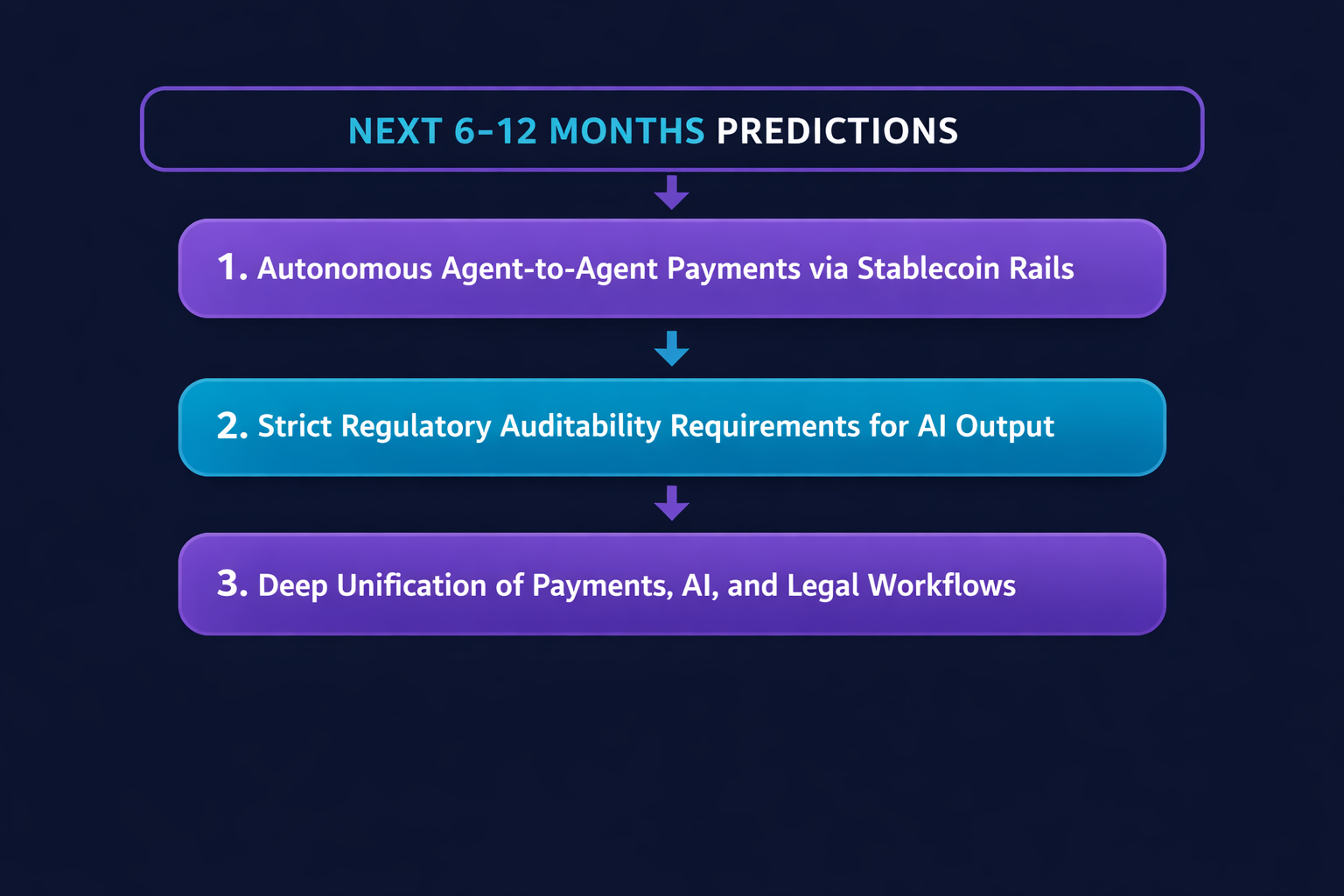
View ASCII source
+------------------------------------------------------------------+
|                   NEXT 6-12 MONTHS PREDICTIONS                  |
+------------------------------------------------------------------+
|  1. Autonomous Agent-to-Agent Payments via Stablecoin Rails     |
|  2. Strict Regulatory Auditability Requirements for AI Output    |
|  3. Deep Unification of Payments, AI, and Legal Workflows       |
+------------------------------------------------------------------+
We will likely witness the emergence of the first fully autonomous machine-to-machine transactions conducted at scale. An AI agent running on Anthropic's infrastructure could draft an agreement using automated legal templates, evaluate risk metrics via machine learning models, execute the agreement on an integrated infrastructure like Stripe, and settle payment instantaneously using a MiCA-compliant stablecoin like Revolut's EURR—all in seconds, with zero manual human intervention.
Regulators in both North America and Europe will naturally intensify their scrutiny of these integrated systems. As stablecoin frameworks like MiCA come into full effect, regulators will demand complete transparency into AI-driven financial routing and contract execution logic. Companies that proactively invest in auditable, deterministic, and security-first system architectures will win market share while navigating compliance mandates smoothly.
Conclusion
The simultaneous convergence of Anthropic’s scaling vision, Revolut’s EURR stablecoin launch, and Stripe’s expansion into legal tech reflects a major evolution in digital commerce. Artificial intelligence provides the contextual reasoning engine, stablecoins deliver instantaneous financial infrastructure, and modern legal software supplies the regulatory structure.
For forward-thinking businesses and software builders, waiting on the sidelines is no longer a viable strategy. Modern software architectures must embrace machine learning automation, API-driven financial rails, and smart legal infrastructure to remain competitive in a world where technology is re-writing the rules of business execution.
Build With Developers of Chicago
If this kind of AI capability matters to your product, you need a team that can actually ship it. Developers of Chicago helps startups and enterprises design, build, and deploy AI-powered software — from custom integrations to full-scale automation systems.
- AI Integration & Automation — Explore our AI services
- Custom Software Development — See our services
- Mobile App Development — Build with us
- Start a Project — Book a call
Based in Chicago. Building for clients everywhere.