Developers of Chicago Engineering Blog
PayPal Valuation Drops

The recent drop in PayPal’s market valuation has sent ripples through the financial technology sector, serving as a critical barometer for the broader tech ecosystem. For years, digital payment processors enjoyed sky-high multiples fueled by rapid e-commerce growth, low interest rates, and accelerated consumer adoption of digital wallets. However, as macroeconomic headwinds tighten profit margins and investor appetite shifts from top-line expansion to sustainable profitability, even established giants are facing intense valuation recalibrations. This shift highlights a fundamental reality in modern tech: standing still or relying on legacy software infrastructure is a recipe for market erosion.
Beyond the stock tickers and financial headlines, PayPal’s valuation shift reflects a pivotal moment in software engineering and digital commerce. The market is aggressively re-evaluating platforms that fail to rapidly integrate advanced machine learning, hyper-personalized user experiences, and automated operational architecture. As traditional payment processing becomes increasingly commoditized, value creation is moving toward intelligent automation, real-time risk assessment, and frictionless agentic commerce. For technology leaders, founders, and software developers, this situation offers vital lessons in enterprise resilience, software modernization, and the critical role of AI in defending market share.
What Happened
PayPal’s valuation adjustment stems from a combination of mounting market pressures, shifting product mix profitability, and intense competition across the digital payment landscape. During the height of the e-commerce surge, payment volumes soared, driving historical revenue figures. However, as consumer shopping patterns normalized and global inflation impacted discretionary spending, payment processors faced lower transaction growth rates. Compounding these top-line challenges was a squeeze on transaction margins, driven largely by the changing composition of PayPal's processing volume.
A primary technical and business driver behind this margin pressure is the divergence between PayPal's branded checkout and its unbranded processing services, such as Braintree. While branded checkout carries high margins due to consumer trust and integrated loyalty features, unbranded payment gateway services operate in a hyper-competitive, lower-margin environment alongside rivals like Stripe and Adyen. As unbranded processing grew to represent a larger percentage of total payment volume (TPV), overall net take rates compressed. To address these realities, PayPal’s executive leadership initiated a strategic pivot, placing deep investments in artificial intelligence, operational automation, and platform consolidation at the center of their turnaround roadmap.
Key Details
At an operational and technical level, managing a payment engine at PayPal’s scale is an extraordinary engineering feat. The platform processes hundreds of billions of dollars in volume across hundreds of millions of active accounts globally. Handling this volume requires massive microservice architectures, sub-second transaction routing, and continuous security compliance across disparate regulatory jurisdictions. However, decades of rapid scaling and strategic acquisitions can lead to architectural fragmentations, legacy technical debt, and isolated data silos that hinder rapid product iteration.
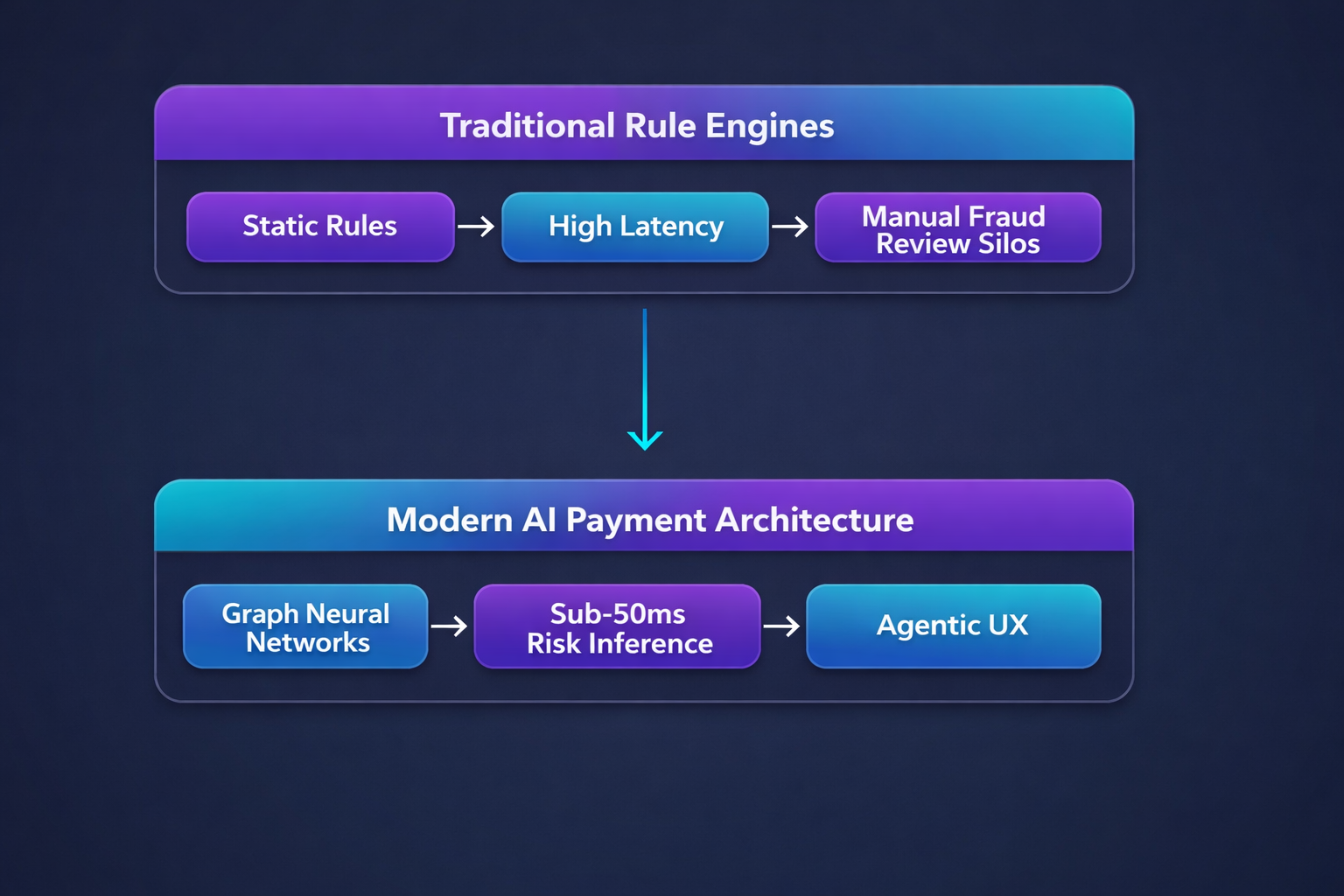
View ASCII source
+-----------------------------------------------------------------------+
|                       Traditional Rule Engines                        |
|   Static Rules  --->  High Latency  --->  Manual Fraud Review Silos   |
+-----------------------------------------------------------------------+
                                   │
                                   ▼
+-----------------------------------------------------------------------+
|                    Modern AI Payment Architecture                      |
|  Graph Neural Networks  -->  Sub-50ms Risk Inference  --> Agentic UX  |
+-----------------------------------------------------------------------+
To counter margin compression and boost developer velocity, the company has focused heavily on rebuilding core infrastructure around unified data layers and machine learning models:
- Real-Time Fraud & Risk Mitigation: Moving away from static, rule-based systems toward deep learning models and graph neural networks capable of evaluating thousands of risk signals in under 50 milliseconds.
- Predictive Checkout & Personalization: Utilizing predictive analytics to tailor payment options, dynamic conversion hooks, and targeted offers based on historical user interaction data.
- Developer Platform Modernization: Streamlining API surfaces, consolidating backend routing protocols, and leveraging machine learning for automated code migration and API integration testing.
- Operational Cost Reduction: Implementing internal AI models to automate routine customer service tickets, chargeback processing, and cross-border regulatory compliance workflows.
Impact on the AI Industry
The challenges faced by legacy fintech leaders have direct, far-reaching implications for the artificial intelligence landscape. Financial services have long served as one of the most lucrative proving grounds for applied machine learning, automated compliance, and predictive modeling. As payment margins tighten, financial institutions are forced to pivot from viewing AI as an experimental research division to treating intelligent systems as core operational infrastructure required to defend gross margins.
This competitive dynamic is triggering a massive wave of technological innovation across several key areas:
- Demand for Low-Latency Inference Engines: Payment networks operate under stringent latency SLAs. Machine learning models deployed for real-time fraud detection must render decisions in milliseconds without causing transaction drop-offs.
- Growth of Fraud-Detection Machine Learning: Sophisticated generative AI tools are being weaponized by bad actors to launch automated credential stuffing, synthetic identity creation, and dynamic phishing attacks. In response, enterprise payment platforms are spending aggressively on deep learning systems capable of pattern recognition across millions of concurrent streams.
- Shift Toward Agentic Commerce: The emerging paradigm of autonomous AI agents executing tasks on behalf of users requires payment infrastructure that natively supports automated micro-transactions, smart contract routing, and programmatic identity verification.
| AI Application Area | Legacy Architecture | Modern AI-Driven Standard |
|---|---|---|
| Fraud Detection | Rule-based engine, manual reviews | Sub-50ms Graph Neural Networks (GNNs) |
| Customer Checkout | Static payment button placement | Predictive dynamic UX & context-aware routing |
| Support & Compliance | Manual ticket processing, offshore centers | Agentic LLM automation & RAG pipelines |
| Developer Integration | Static SDKs, manual documentation | Dynamic API orchestration & automated testing |
What Developers and Businesses Should Know
For software engineers, product managers, and enterprise decision-makers, PayPal’s situation offers clear, actionable insights for modern system architecture and product strategy. Relying solely on brand equity or early-mover advantages is no longer a viable long-term defense. Tech teams must continually modernize their technology stack, build around data-centric paradigms, and integrate machine learning into core product workflows.
First, static software rules engines are fundamentally obsolete for high-throughput enterprise applications. Whether you are building payment gateways, e-commerce platforms, or SaaS tools, system logic must transition from rigid conditional code to dynamic, continually trained machine learning models. Implementing vector search databases, real-time feature stores, and robust MLOps pipelines allows software systems to automatically adjust to evolving user behaviors and market anomalies without requiring manual code updates.
Second, practical operational automation is the most effective tool for expanding gross margins. Organizations shouldn't view AI tools like Large Language Models (LLMs) or Retrieval-Augmented Generation (RAG) merely as consumer-facing chatbots. Instead, they should deploy them internally to streamline administrative overhead, accelerate developer onboarding, automate routine technical support, and reduce customer acquisition costs. Enterprise engineering teams that embed machine learning directly into operational workflows consistently deliver better software faster, maintaining lean cost structures even during economic slowdowns.
Future Outlook
Over the next 6 to 12 months, the digital payments and software technology sectors will undergo an intense operational reset. Expect payment platforms to double down on deep platform consolidation, divesting non-core business assets to fund core AI infrastructure. Organizations that succeed in deploying deep learning across their stack will see immediate margin recovery driven by lower fraud rates, higher checkout conversion, and significantly reduced customer service operating costs.
Furthermore, we are on the precipice of a major structural shift toward programmatic, AI-driven commerce. As autonomous software agents become integrated into web browsers, enterprise enterprise resource planning (ERP) systems, and consumer mobile apps, the way transactions are initiated and settled will fundamentally change. Payment platforms that provide robust, developer-friendly APIs designed specifically for automated bot interactions, programmatically verified identity, and instant risk scoring will capture the next generation of transactional market share. Those that fail to modernize risk being relegated to legacy backend clearinghouses.
Conclusion
PayPal’s valuation contraction is not a sign of the death of digital payments; rather, it marks the end of simple, unoptimized transaction processing as a high-margin enterprise business model. As software markets mature, long-term competitive advantages belong to organizations that blend seamless user experience with deep machine learning, automated system execution, and rock-solid software architecture.
Whether managing global payment volumes or launching an early-stage software initiative, modern enterprise success relies on technical agility. Prioritizing AI integration, continuous optimization, and modern data infrastructure ensures companies don't just weather macroeconomic market shifts—they lead them.
Build With Developers of Chicago
If this kind of AI capability matters to your product, you need a team that can actually ship it. Developers of Chicago helps startups and enterprises design, build, and deploy AI-powered software — from custom integrations to full-scale automation systems.
- AI Integration & Automation — Explore our AI services
- Custom Software Development — See our services
- Mobile App Development — Build with us
- Start a Project — Book a call
Based in Chicago. Building for clients everywhere.