Developers of Chicago Engineering Blog
Meet the innovators under 35 shaping climate tech

Introduction
The intersection of artificial intelligence and environmental sustainability represents one of the most critical technological frontiers of the twenty-first century. As global industries face unprecedented pressure to reduce carbon footprints, transition to renewable energy sources, and meet stringent regulatory requirements, technology is stepping up to bridge the gap between ambitious climate goals and real-world execution. At the heart of this revolution are young researchers, software engineers, data scientists, and entrepreneurs who are reimagining how we solve complex ecological problems using cutting-edge computational tools.
Each year, MIT Technology Review publishes its prestigious "35 Innovators Under 35" list, recognizing exceptional young minds whose work promises to reshape the future. The latest cohort highlights a powerful shift: nine of these standout innovators are dedicating their expertise directly to climate technology. From physics-informed machine learning models that optimize renewable energy grids to algorithmic platforms for precision agriculture and automated carbon capture, these pioneers demonstrate that modern software and artificial intelligence are essential assets in the fight against climate change. Understanding their work offers a compelling blueprint for how AI will drive industrial sustainability over the coming decade.
What Happened
The annual unveiling of MIT Technology Review’s "35 Innovators Under 35" serves as a benchmark for the global technology ecosystem. This year's release puts a dedicated focus on climate tech, featuring nine trailblazers selected from thousands of global nominees. The editorial team spent months evaluating candidates across academia, venture-backed startups, and corporate research labs, looking for individuals whose technical novelties offer scalable, commercially viable solutions to complex environmental challenges.
What sets this year’s climate cohort apart is their deep reliance on advanced computing, data engineering, and machine learning. Rather than relying solely on traditional mechanical engineering or policy frameworks, these innovators are deploying complex software systems to accelerate clean technology deployment. Their work spans multiple continents and addresses diverse problems, including accelerating battery material discovery, predicting atmospheric methane leaks in real time, and engineering synthetic biology solutions using computational models.
This recognition reflects a broader structural change in the technology landscape. Climate tech is no longer viewed as a slow-moving, hardware-only sector dependent entirely on government subsidies. Today, it is a fast-growing industry powered by venture capital, enterprise adoption, and modern AI stack development. The inclusion of nine climate-focused visionaries in this year's list highlights how computer science and AI are becoming foundational tools for solving physical, multi-variable climate problems at enterprise scale.
Key Details
The technical breakthroughs pioneered by this year’s climate innovators showcase the versatility of modern machine learning and computational modeling. To appreciate their impact, it is essential to examine the specific technical domains, software methodologies, and industrial applications these innovators are advancing:
- Accelerated Materials Discovery for Clean Energy: Traditional battery chemistry research requires years of physical laboratory experimentation. Innovators in this year's class are leveraging generative AI models and graph neural networks (GNNs) to simulate molecular structures at quantum levels. By accurately predicting atomic interactions, these algorithms reduce the time needed to synthesize next-generation solid-state batteries and novel catalysts for hydrogen production from decades down to mere months.
- Predictive Grid Management and Optimization: Integrating volatile, intermittent renewable energy sources—such as wind and solar—into legacy power grids requires real-time computational balancing. Young researchers are deploying deep reinforcement learning (DRL) algorithms and physics-informed neural networks (PINNs) to forecast energy demand, predict micro-weather patterns, and automatically re-route power across distributed microgrids, drastically reducing dynamic energy losses.
- Satellite Remote Sensing and Automated Emissions Tracking: Tracking greenhouse gas emissions historically relied on manual site inspections and self-reported corporate disclosures. Innovators are combining computer vision with high-resolution multispectral satellite imagery to continuously map methane plumes, deforestation, and industrial point-source emissions globally. These computer vision pipelines process terabytes of spatial data daily, delivering high-frequency, verifiable telemetry directly to regulators and enterprise ESG platforms.
- AI-Driven Synthetic Biology and Carbon Capture: Bioremediation and biological carbon sequestration require precision engineering of micro-organisms. Using generative protein design models, climate researchers are engineering custom enzymes designed to break down persistent industrial polymers and capture ambient carbon dioxide at significantly higher rates than naturally occurring organisms.

View ASCII source
+-----------------------------------------------------------------------+
|                 AI-Driven Climate Tech Architecture                   |
+-----------------------------------------------------------------------+
|  [ Data Ingestion ]   -> Multispectral Satellites, IoT Sensors, Grids  |
|         │                                                             |
|         ▼                                                             |
|  [ ML Pipeline ]     -> Spatial Transformers, Graph Neural Networks  |
|         │                                                             |
|         ▼                                                             |
|  [ Action Engine ]   -> Dynamic Load Balancing, Material Synthesis,   |
|                         Automated Carbon Accounting & Reporting       |
+-----------------------------------------------------------------------+
These technical implementations demonstrate that solving climate problems requires sophisticated big data ingestion pipelines, specialized model architectures, and cloud-native software infrastructure capable of running massive distributed simulations.
Impact on the AI Industry
The work of these young innovators is altering the trajectory of the artificial intelligence industry itself. For several years, the mainstream AI conversation has been dominated by large language models (LLMs) and consumer-facing generative text and image systems. However, climate technology presents a fundamentally different paradigm: physical-world AI. This branch of machine learning must adhere strictly to the laws of physics, chemistry, and thermodynamics, driving software architects to create more precise, multi-modal, and specialized intelligence tools.
This convergence is pushing the boundaries of spatial-temporal modeling and physics-informed AI architectures. Standard deep learning models often struggle when applied to turbulent climate systems or high-stakes electrical infrastructure because pure statistical extrapolation can yield physically impossible outputs. To address this, climate tech innovators are pioneering hybrid AI systems that embed partial differential equations directly into loss functions. This ensures that algorithmic predictions comply with conservation of mass and energy principles, accelerating the adoption of AI in aerospace, materials science, and heavy industrial automation.
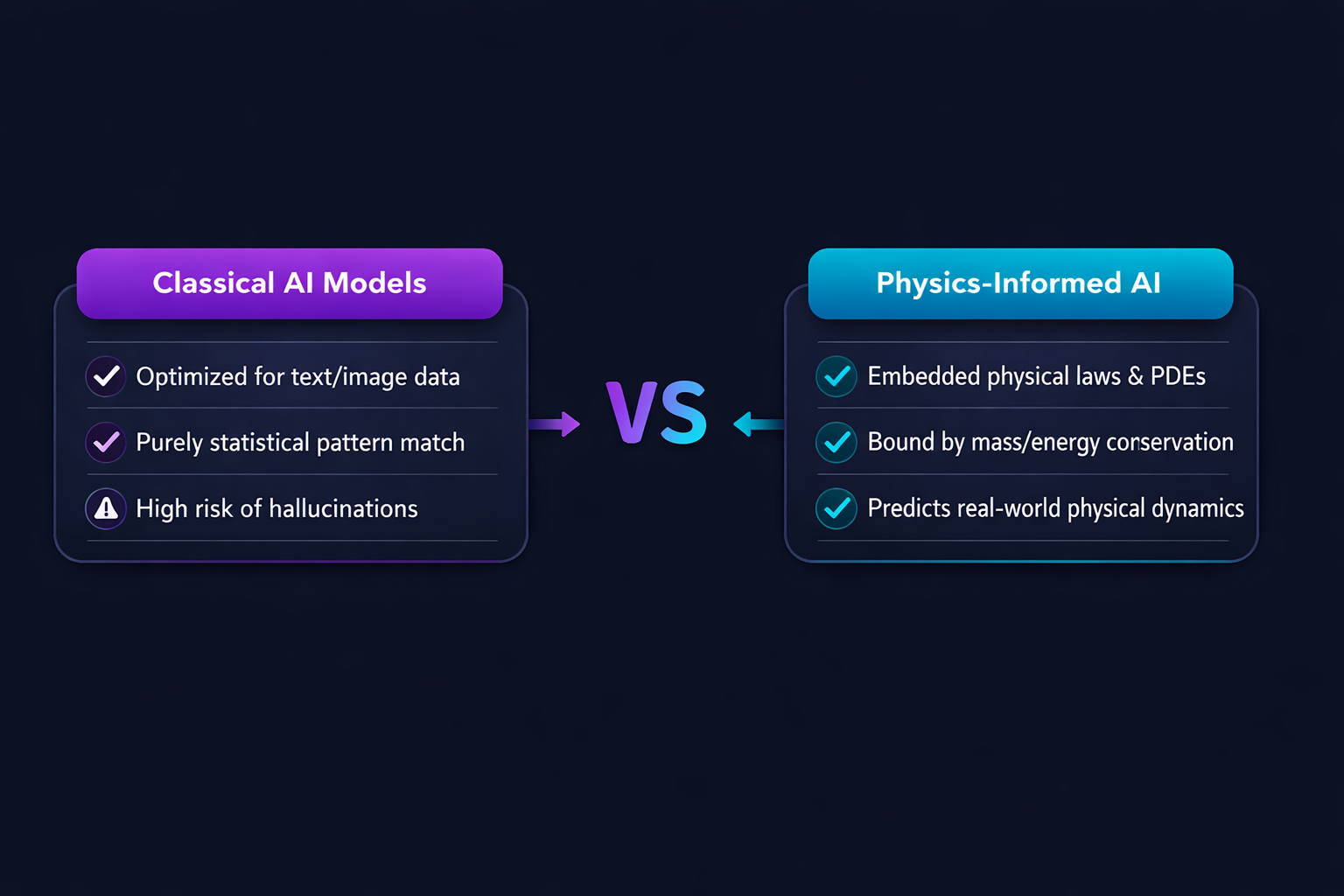
View ASCII source
       [ Classical AI Models ]                  [ Physics-Informed AI ]
┌────────────────────────────────────┐    ┌────────────────────────────────────┐
│ • Optimized for text/image data    │    │ • Embedded physical laws & PDEs    │
│ • Purely statistical pattern match │ vs │ • Bound by mass/energy conservation│
│ • High risk of hallucinations      │    │ • Predicts real-world physical dynamics│
└────────────────────────────────────┘    └────────────────────────────────────┘
Furthermore, the rise of climate tech AI is pushing software organizations to address the computational footprint of AI training and inference itself. As training models consume larger amounts of electricity, these innovators are leading the charge toward "Green AI"—developing energy-efficient model architectures, neural network pruning strategies, and dynamic workload orchestration systems that shift heavy model training jobs to regions and times when renewable energy on the grid is abundant.
What Developers and Businesses Should Know
For software engineering teams, product leaders, and enterprise decision-makers, the rise of AI-driven climate technology offers actionable strategic takeaways. Climate considerations are moving from simple corporate social responsibility reports to core engineering, product architecture, and operational workflows.
1. Capitalize on Geospatial and Physical Open Datasets
Building climate-intelligent applications no longer requires gathering proprietary training data from scratch. Modern developers should take advantage of robust open-source climate frameworks and satellite datasets made available by organizations like NASA, ESA, and open-source foundations. Foundation models built specifically for geospatial data—such as NASA and IBM’s open-source Prithvi model—allow software teams to fine-tune pre-trained vision transformers for land-use classification, flood risk prediction, and infrastructure monitoring using minimal labeled training data.
2. Implement Dynamic Resource Optimization
Businesses operating high-density server environments, logistics networks, or manufacturing plants can directly apply the optimization methodologies pioneered by climate tech researchers. Integrating predictive analytics into enterprise systems allows software systems to dynamically adjust compute workloads based on grid carbon intensity, optimize vehicle fleet routing in real time, and reduce HVAC energy expenditure in physical facilities through automated IoT predictive control loops.
3. Prepare for Granular Climate Data Regulations
With the implementation of strict climate reporting standards—such as the European Union’s Corporate Sustainability Reporting Directive (CSRD) and evolving SEC climate disclosure regulations—businesses need robust data engineering architecture. Manual data collection and static spreadsheets are no longer sufficient for regulatory compliance. Enterprise IT teams must build real-time, automated carbon accounting pipelines capable of tracking direct emissions (Scope 1), energy purchases (Scope 2), and extended supply chain operational metrics (Scope 3) with full audibility.
Future Outlook
Over the next 6 to 12 months, the innovations pioneered by this cohort of innovators will transition rapidly from pilot deployments into mainstream commercial adoption. As venture capital funds deploy clean tech capital into software-enabled platforms, startups operating at the intersection of AI and climate tech will see accelerated funding cycles. We anticipate widespread commercialization of high-frequency atmospheric monitoring systems, automated industrial energy management software, and enterprise-grade supply chain carbon intelligence platforms.
At the software engineering level, expect closer convergence between generative AI models and physical simulation frameworks. Leading cloud providers will likely introduce specialized, turn-key foundation models for chemical processing, spatial reasoning, and weather forecasting directly into their AI infrastructure services. This democratization will lower the barrier to entry, allowing mid-tier enterprises and independent development teams to build climate-aware logic directly into consumer and business applications.
Looking further ahead, regulatory enforcement and market incentives will turn climate software into a standard enterprise requirement rather than a niche discipline. Companies that proactively integrate real-time spatial telemetry, automated energy balancing, and optimized algorithmic resource management into their core operations will enjoy significant operational cost advantages, lower risk exposure, and superior regulatory compliance compared to slower competitors.
Conclusion
The recognition of nine climate technology leaders in MIT Technology Review’s "35 Innovators Under 35" underscores a pivotal evolution in technology. Artificial intelligence and modern software engineering have transcended digital-only applications, emerging as foundational tools required to address pressing physical and environmental challenges. By combining machine learning, spatial compute, and physics-grounded algorithms, these young innovators are showing how advanced computational tools can drive measurable, real-world sustainability.
For software developers, technical leaders, and enterprises, this inflection point presents both a responsibility and a substantial market opportunity. The techniques refined in climate research—from physics-informed neural networks to continuous remote sensing data pipelines—offer powerful patterns for modern software architecture. Embracing these advanced AI capabilities enables organizations to build more efficient infrastructure, deliver verifiable sustainability outcomes, and succeed in an increasingly energy-conscious global economy.
Build With Developers of Chicago
If this kind of AI capability matters to your product, you need a team that can actually ship it. Developers of Chicago helps startups and enterprises design, build, and deploy AI-powered software — from custom integrations to full-scale automation systems.
- AI Integration & Automation — Explore our AI services
- Custom Software Development — See our services
- Mobile App Development — Build with us
- Start a Project — Book a call
Based in Chicago. Building for clients everywhere.