Developers of Chicago Engineering Blog
How to Use GPT-6 Astra, the OpenAI Model Jensen Huang Called AGI
Introduction
When NVIDIA CEO Jensen Huang takes the stage and publicly declares an artificial intelligence model as achieving Artificial General Intelligence (AGI), the entire technology ecosystem takes notice. OpenAI’s newly unveiled flagship model, GPT-6 Astra, has crossed a monumental threshold. It represents a paradigm shift where AI transitions from a helpful text generator into an autonomous, reasoning co-worker capable of executing complex end-to-end workflows with expert-level precision.
For founders, software engineers, venture capitalists, and enterprise leaders, this moment demands immediate action. Incremental gains in productivity are no longer the primary value proposition of machine learning. Instead, GPT-6 Astra enables complete operational transformations, allowing lean teams to execute at a scale previously reserved for Fortune 500 organizations. The shift from simple prompt-response interactions to deep, autonomous problem-solving unlocks unprecedented potential in software development, financial analysis, and strategic operations.
To capitalize on this technological leap, businesses must understand both the underlying technical achievements of GPT-6 Astra and the practical mechanics of deploying it effectively. This article explores the details of OpenAI's breakthrough, analyzes its broad industry impact, and provides eight production-ready workflows complete with optimized system settings and copy-ready prompts.
What Happened
During a keynote event that brought together leaders across hardware engineering and artificial intelligence research, Jensen Huang officially labeled OpenAI’s GPT-6 Astra as the industry's first true operational AGI system. Pointing to Astra’s ability to reason dynamically, self-correct complex execution paths, and manipulate software environments in real time, Huang emphasized that the boundary between human cognitive output and machine execution has effectively dissolved.
OpenAI's unveiling of Astra surprised the market not just with raw parameter scale, but with an architectural leap in multi-step reasoning capabilities. Unlike previous generations that relied heavily on static next-token prediction, GPT-6 Astra incorporates adaptive system-2 thinking, direct hardware-accelerated tool use, and integrated long-term memory streams. The system evaluates its own intermediate outputs, identifies logical oversights, and dynamically allocates additional compute when faced with high-complexity problem domains.
The announcement represents the culmination of deep technical hardware and software co-design between OpenAI and NVIDIA. By leveraging next-generation GPU cluster architectures, Astra achieves real-time inference speeds even while undertaking massive contextual evaluation tasks, turning theoretical AI benchmarks into actionable enterprise utility.
Key Details
The technical architecture of GPT-6 Astra sets new benchmarks across every major artificial intelligence metric. At its foundation, Astra is a native multimodal transformer designed to process text, high-definition visual inputs, streaming audio, compiled code binaries, and structured spatial vectors simultaneously without requiring separate specialized encoders.

View ASCII source
+-----------------------------------------------------------------------------------+
|                                 GPT-6 Astra Core                                  |
+------------------------------------------+----------------------------------------+
| Dynamic Reasoning Engine                 | Continuous Context Sync                |
| - Variable compute allocation            | - Multi-session state retention        |
| - Real-time step-by-step verification    | - Real-time knowledge graph updates    |
+------------------------------------------+----------------------------------------+
| Native Multimodal IO                     | Autonomous Tool Orchestration          |
| - Code, vision, audio, text, spatial     | - Native API execution & sandboxing    |
| - Zero-latency streaming inference       | - Zero-shot environment navigation     |
+-----------------------------------------------------------------------------------+
Key technical features defining GPT-6 Astra include:
- Dynamic Compute Budgeting: Astra dynamically scales its internal thinking budget based on query complexity, spending more processing cycles on structural engineering problems or financial audits while responding instantaneously to routine administrative tasks.
- Continuous Knowledge Graph Synchronization: Moving past traditional fixed context windows, Astra maintains persistent memory structures that continuously update and index operational context across weeks of active development work.
- Zero-Latency Native Multimodality: The model processes real-time video streams and audio feeds with near-zero latency, enabling instant physical and digital interface navigation.
- Autonomous Tool Orchestration: Astra natively interfaces with terminal environments, web browsers, API gateways, and cloud infrastructure pipelines without requiring external middleware or brittle orchestration frameworks.
This integration of software intelligence and hardware compute efficiency allows Astra to execute multi-hour tasks—such as auditing an entire codebase or drafting a comprehensive corporate investment memo—with complete autonomous consistency.
Impact on the AI Industry
The release of GPT-6 Astra marks an inflection point in the competitive dynamics of the global tech economy. Traditional Software-as-a-Service (SaaS) business models are experiencing rapid disruption; off-the-shelf software applications designed for single point-solutions are quickly being superseded by custom, Astra-driven agentic systems tailored precisely to an enterprise's proprietary data and operational workflows.
For venture capital and tech startups, capital efficiency expectations have been permanently recalibrated. Small teams consisting of two or three engineers can now build, ship, and maintain products that previously required engineering organizations of fifty or more people. Startup incubators and enterprise venture funds are shifting focus away from foundational model builders toward application-layer innovators who can successfully integrate Astra into specialized industry verticals.
Furthermore, the alignment between OpenAI and hardware providers signals a new era of hyper-scale infrastructure requirements. As inference dynamic reasoning budgets become standard, the demand for enterprise-grade AI infrastructure, custom integrations, and specialized agent deployment layers will continue to skyrocket across every sector of the global economy.
What Developers and Businesses Should Know
To maximize the performance of GPT-6 Astra, operators must move beyond conversational prompts and structure their interactions using systematic parameters. The model operates best when provided with explicit reasoning budgets, constrained system parameters, and structured output formatting instructions.
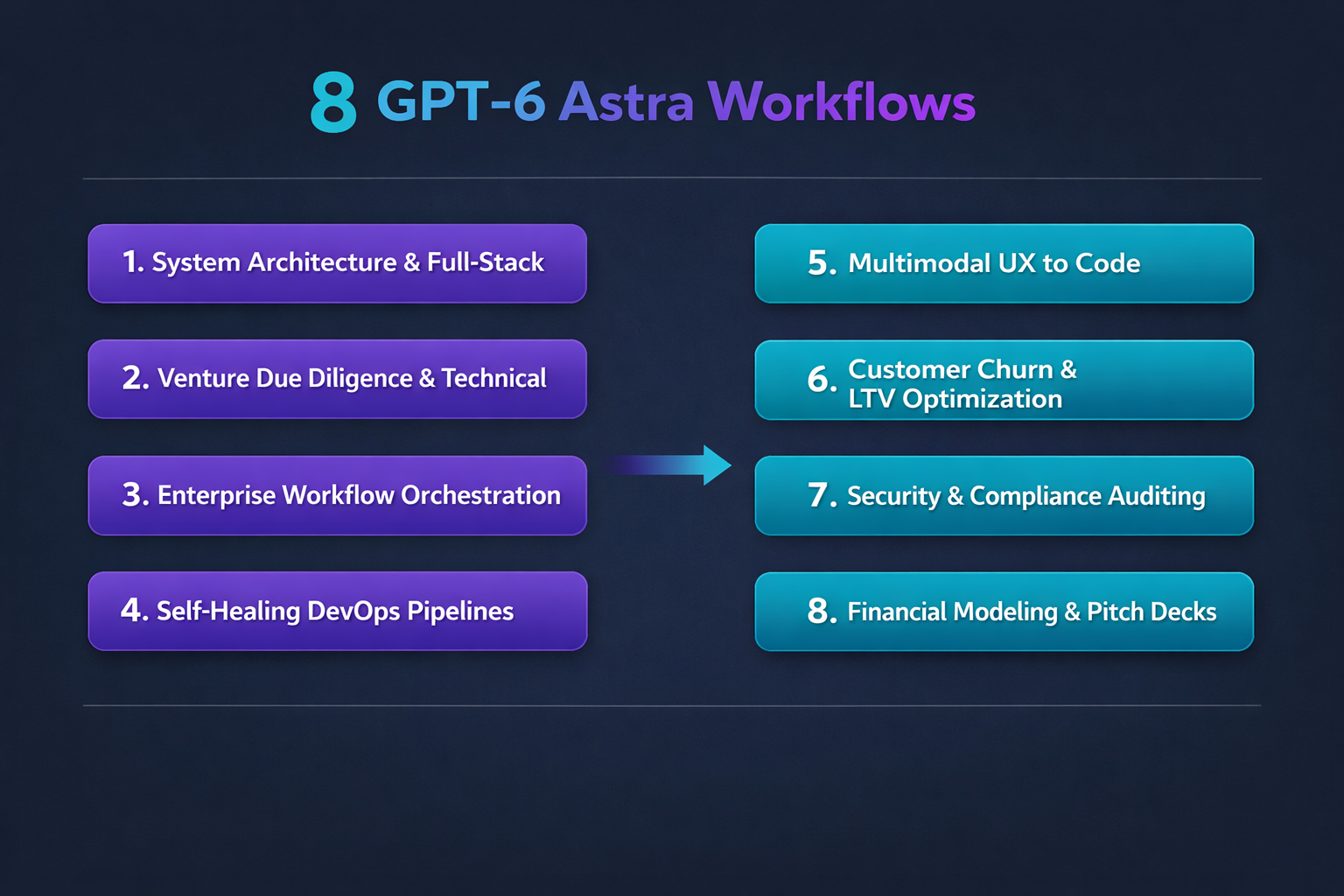
Below are eight practical workflows, system settings, and copy-ready prompts designed for founders, developers, product leaders, and investors looking to harness GPT-6 Astra.
View ASCII source
+-----------------------------------------------------------------------------------+
|                              8 GPT-6 Astra Workflows                              |
+-----------------------------------------+-----------------------------------------+
| 1. System Architecture & Full-Stack     | 5. Multimodal UX to Code                |
| 2. Venture Due Diligence & Technical    | 6. Customer Churn & LTV Optimization    |
| 3. Enterprise Workflow Orchestration    | 7. Security & Compliance Auditing       |
| 4. Self-Healing DevOps Pipelines        | 8. Financial Modeling & Pitch Decks     |
+-----------------------------------------+-----------------------------------------+
Workflow 1: Autonomous System Architecture & Full-Stack Generation
- Best For: Technical founders, lead architects, and senior software engineers.
- Recommended Settings: System Mode: Architect Engine | Reasoning Budget: High | Temperature: 0.2
[System Context: Act as a Principal Cloud Architect and Lead Full-Stack Engineer.]

Analyze the attached enterprise product requirements document (PRD). Design a microservices system architecture that guarantees high availability and low latency.

Your output must include:
1. An ASCII system architecture diagram showing services, databases, cache layers, and message queues.
2. Production-ready Node.js/TypeScript backend API routes using Express and Prisma ORM.
3. Fully implemented PostgreSQL schema migrations with optimized indexing strategies.
4. Comprehensive unit and integration tests using Jest covering edge-case scenarios.

Ensure zero placeholder comments. Provide complete, fully typed, production-ready code blocks.
Workflow 2: Venture Investment & Technical Due Diligence
- Best For: Venture capital investors, angel syndicates, and M&A analysts.
- Recommended Settings: System Mode: Analytical Auditor | Reasoning Budget: Maximum | Memory Mode: Graph-Linked
[System Context: Act as a Managing Director at a Tier-1 Venture Capital Firm specializing in deep tech.]

Evaluate the attached pitch deck, financial model, and technical whitepaper for [Company Name].

Perform a deep-dive investment memo covering:
1. Technical Defensibility: Cross-reference their claims against patent databases and open-source benchmarks.
2. Market Sizing: Calculate realistic TAM/SAM/SOM based on top-down and bottom-up data.
3. Unit Economics Audit: Analyze LTV/CAC ratios, payback periods, and gross margin scaling bottlenecks.
4. Risk Matrix: Highlight the top 5 operational, regulatory, and technical failure modes.

Format the output as a structured investment committee memo with clear "Pass" or "Invest" recommendations.
Workflow 3: Automated Enterprise Workflow Orchestration
- Best For: Operations leaders, founders, and automation specialists.
- Recommended Settings: System Mode: Workflow Engine | Tool Access: Enabled | Temperature: 0.1
[System Context: Act as an Enterprise Automation Engineer specializing in Zapier, n8n, and custom API integration.]

Design an end-to-end automated workflow connecting HubSpot CRM, Zendesk, Stripe, and Slack.

Requirements:
1. Trigger: When a customer cancels a high-tier subscription in Stripe.
2. Action: Extract customer history from HubSpot, parse recent support tickets from Zendesk, and run a churn sentiment analysis.
3. Execution: Generate a custom Python script for an n8n workflow node that processes this data, updates customer records, and posts a prioritized alert to the executive Slack channel with a tailored retention proposal.

Provide the complete Python code along with the structured JSON schema for the automation pipeline.
Workflow 4: Self-Healing DevOps Pipelines
- Best For: DevOps engineers, SREs, and platform teams.
- Recommended Settings: System Mode: Autonomous Execution | Latency Mode: Real-Time Stream
[System Context: Act as a Principal Site Reliability Engineer managing enterprise Kubernetes infrastructure.]

Ingest the following production application stack trace and deployment manifest [Paste Error Logs].

Provide an immediate incident response resolution:
1. Root-Cause Analysis: Identify the precise memory leak, deadlocks, or misconfigured resource limits causing pod crashes.
2. Patch Generation: Provide corrected Kubernetes YAML deployment manifests with optimized CPU/memory requests and liveness probes.
3. Automated Testing Script: Write a Bash script running health checks and load testing to verify the stability of the patch before automated canary deployment.
Workflow 5: Multimodal UI/UX Wireframing to Production Code
- Best For: Product managers, frontend developers, and UI/UX designers.
- Recommended Settings: Input Mode: Multimodal Vision | Temperature: 0.3 | Output: React / Tailwind
[System Context: Act as a Senior Frontend Developer expert in React, Tailwind CSS, and Framer Motion.]

Examine the attached image mockup of the user interface dashboard [Attach Screenshot].

Recreate this visual interface into clean, accessible component code:
1. Code Structure: Write modular React components utilizing Tailwind CSS for styling.
2. Interactivity: Include Framer Motion animations for hover states, modal transitions, and dynamic loading states.
3. Accessibility: Ensure proper ARIA tags, keyboard navigation support, and full mobile responsiveness.

Return full, self-contained component files ready for deployment into a Next.js application.
Workflow 6: Predictive Customer Churn & Lifetime Value Modeling
- Best For: Growth marketers, revenue teams, and data analysts.
- Recommended Settings: System Mode: Data Scientist | Analytical Budget: Deep | Temperature: 0.2
[System Context: Act as a Lead Data Scientist specializing in subscription SaaS metrics and churn prevention.]

Analyze the provided customer usage dataset [Paste CSV Data].

Identify critical behavioral churn triggers and generate actionable retention logic:
1. Key Metrics: Calculate dynamic customer retention curves and churn probability scores for active cohorts.
2. Trigger Identification: Highlight specific drop-offs in feature usage that correlate with account cancellations within 30 days.
3. Campaign Logic: Write personalized, automated email outreach sequences tailored specifically to at-risk enterprise accounts, targeting their exact feature drop-off causes.
Workflow 7: Security & Compliance Auditing
- Best For: Chief Information Security Officers (CISOs), compliance officers, and backend engineers.
- Recommended Settings: System Precision: Strict | Temperature: 0.0 | Reasoning Budget: High
[System Context: Act as a Cybersecurity Penetration Tester and Compliance Auditor.]

Audit the following smart contract and API authentication backend code [Insert Code Segment] against SOC2 Type II, HIPAA, and OWASP Top 10 security standards.

Provide:
1. Vulnerability Log: List every vulnerability with its corresponding CVSS score and exploit mechanism.
2. Code Refactoring: Supply updated, hardened source code that fully mitigates each security gap.
3. Audit Documentation: Draft the formal compliance attestation report explaining how the remediated code complies with security standard frameworks.
Workflow 8: Financial Modeling & Pitch Deck Generation
- Best For: Startup founders, CFOs, and corporate strategy teams.
- Recommended Settings: System Mode: Strategic Financial Controller | Format: Structured & Formatted
[System Context: Act as a Tech CFO and Startup Fundraising Advisor.]

Build a comprehensive financial forecasting model for a B2B SaaS startup operating on a hybrid subscription and usage-based pricing structure.

Parameters:
- Base Price: $499/month + $0.05 per API call.
- Initial CAC: $1,200 | Net Revenue Retention (NRR): 118% | Monthly Churn Goal: < 1.5%.

Output Requirements:
1. Provide a 36-month P&L model breakdown in structured table format with exact formulas.
2. Calculate projected Burn Multiple, Runway, and Gross Margin trajectory accounting for GPU infrastructure costs.
3. Draft a slide-by-slide outline for a Series A pitch deck emphasizing these financial mechanics.
Future Outlook
Over the next 6 to 12 months, the deployment of models like GPT-6 Astra will fundamental shift from passive command-line usage to background ambient automation. Organizations will move beyond using single prompts, transitioning instead toward multi-agent orchestration environments where specialized instances of Astra continuously manage internal communications, code reviews, deployment pipelines, and customer success management without requiring continuous human prompting.
As hardware infrastructure accelerates and spatial-visual processing matures, local edge execution of these advanced reasoning models will bring autonomous intelligence directly to IoT devices, robotics, and mobile applications. Businesses that prioritize integrating agentic workflows today will hold an insurmountable operational speed advantage as AGI capabilities continue to compound over the coming years.
Conclusion
Jensen Huang's declaration that OpenAI’s GPT-6 Astra represents the arrival of AGI marks a clear turning point for the tech industry. Astra is more than an incremental improvement—it is an autonomous platform capable of processing dynamic information, writing complex software, auditing venture investments, and executing end-to-end operational workflows at scale.
To remain competitive in this shifting landscape, founders, developers, and executive leaders must move rapidly from exploration to implementation. By embedding models like GPT-6 Astra into core product architectures and business operations, organizations can operate with unprecedented speed and efficiency. The future belongs to those who build with precision, leverage cutting-edge intelligence, and ship products faster than ever before.
Build With Developers of Chicago
If this kind of AI capability matters to your product, you need a team that can actually ship it. Developers of Chicago helps startups and enterprises design, build, and deploy AI-powered software — from custom integrations to full-scale automation systems.
- AI Integration & Automation — Explore our AI services
- Custom Software Development — See our services
- Mobile App Development — Build with us
- Start a Project — Book a call
Based in Chicago. Building for clients everywhere.