Developers of Chicago Engineering Blog
Donated livers can be made biologically younger
Introduction
For decades, organ transplantation has been defined by a desperate, high-stakes race against time. The moment a donor liver is removed, ischemic injury begins. The traditional clinical standard—flushing the organ with a cold preservation solution, placing it in a plastic bag, and packing it in an insulated cooler on ice—is little more than an effort to slow down inevitable cellular decay. Under static cold storage, surgeons have a agonizingly narrow window, typically between 8 and 12 hours, to transport the organ, match it to a suitable recipient, and complete complex transplant surgery. Every minute that passes increases the risk of primary non-function, graft dysfunction, and post-operative complications.
This severe time constraint has long exacerbated a global healthcare crisis. Thousands of patients die each year on organ waitlists while end-stage liver disease rates climb globally. To make matters worse, a staggering percentage of donated livers are ultimately discarded because they are deemed too old, too fatty (steatotic), or too vulnerable to withstand the trauma of cold storage and subsequent reperfusion.
However, a revolutionary convergence of biomedical engineering, advanced machine learning, and normothermic organ perfusion is turning this paradigm on its head. Researchers and medical innovators have demonstrated that donated organs do not simply have to be preserved in a state of suspended decay—they can be kept alive, continuously evaluated by AI-driven diagnostics, and actively rejuvenated at a cellular level. By turning back the biological clock of marginal donor livers, artificial intelligence and continuous machine perfusion are transforming organ transplantation from an emergency logistics nightmare into a controlled, bio-engineered healthcare process.
What Happened
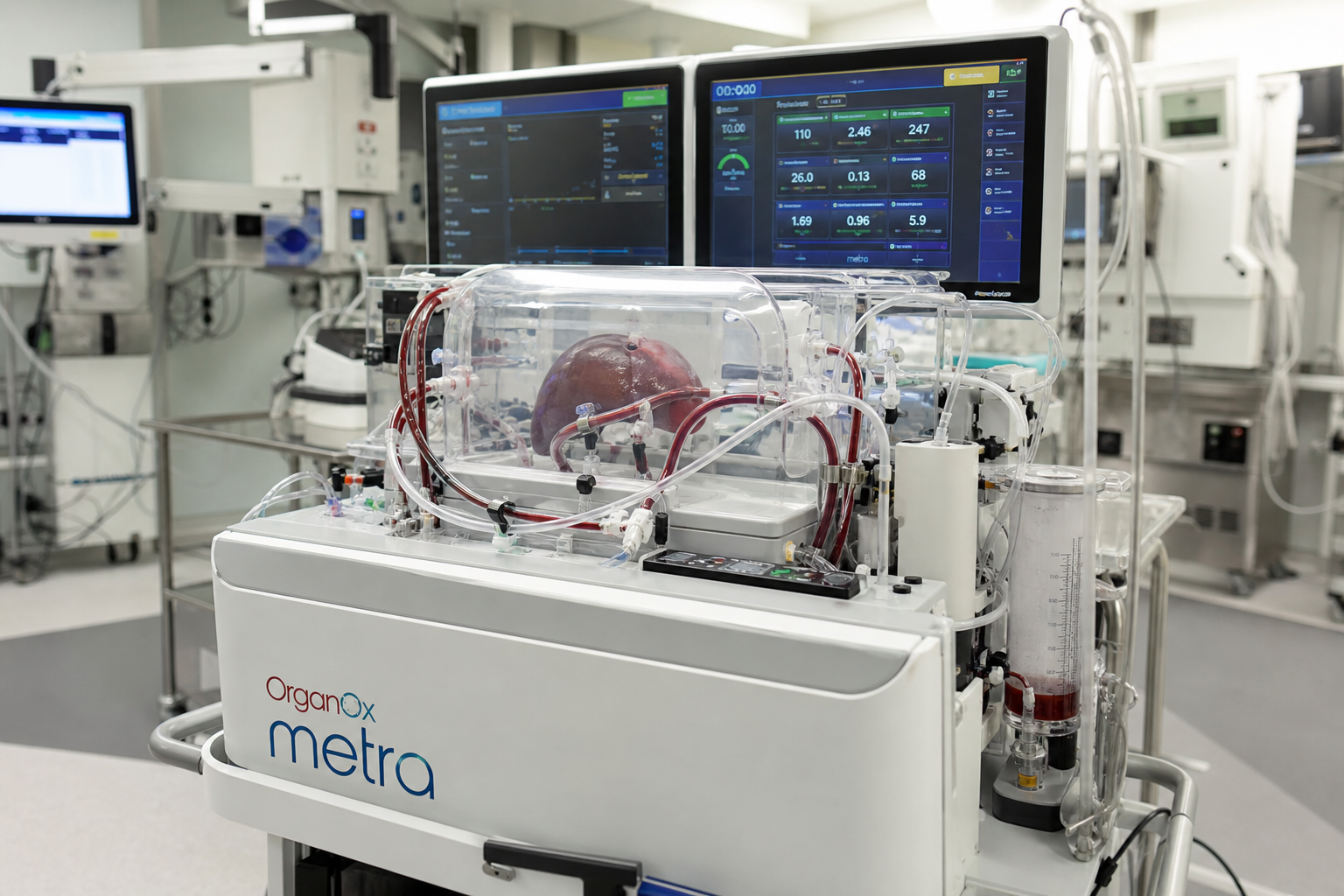
The fundamental breakthrough relies on replacing passive static cold storage with normothermic machine perfusion (NMP). Instead of freezing the donor liver to slow its metabolism, NMP systems keep the organ at normal physiological body temperature (37°C or 98.6°F) and continuously pump a oxygenated, nutrient-rich blood fluid through its vascular network. Inside this warm, dynamic environment, the liver remains metabolically active: it produces bile, synthesizes proteins, metabolizes lactate, and maintains vascular tone just as it would inside a human body.
The transformative leap occurs when normothermic perfusion is coupled with intelligent machine learning models and targeted molecular therapies. While the organ is perfusing, an array of sensors and high-resolution cameras track hundreds of physiological and biochemical parameters in real time. Advanced machine learning algorithms analyze complex multi-modal data streams—monitoring everything from microvascular blood flow and oxygen consumption to metabolic clearance and surface tissue color changes—to calculate precise organ viability metrics.
Beyond simple assessment, medical teams are now utilizing this AI-monitored window to administer therapeutic cocktails directly to the liver. By infusing senolytics (compounds that clear aged, damaged cells), RNA-based therapies, lipid-clearing agents, and anti-inflammatory drugs into the perfusate, researchers have successfully reversed cellular senescence, cleared fat accumulation, and restored mitochondrial function. In essence, the liver is not merely kept alive outside the body; its biological age is rolled back, making marginal or previously rejected livers healthier and functionally younger than they were at the time of donation.
Key Details
The mechanics of AI-assisted organ rejuvenation represent a triumph of deeptech integration, combining advanced hardware robotics, real-time edge computing, and biological analytics.
- Multi-Modal Sensor Integration: Modern NMP platforms are equipped with dynamic bio-sensors measuring arterial and venous pressure, microvascular flow velocity, pH, partial pressures of oxygen and carbon dioxide, and glucose/lactate ratios. Simultaneously, computer vision models analyze continuous video feeds of the organ to detect subtle alterations in tissue turgor, color uniformity, and localized ischemia.
- Predictive Machine Learning Viability Models: Rather than relying on static, point-in-time blood tests, algorithms process continuous time-series data to predict post-transplant function. Deep learning models trained on thousands of perfusion hours can accurately forecast whether a marginal liver will succeed in a recipient, eliminating much of the guesswork previously required of surgical teams.
- Closed-Loop Automated Interventions: Emerging perfusion platforms utilize automated control loops driven by algorithmic inference. When the AI detects signs of metabolic stress or cellular fatigue, the system can automatically adjust perfusate temperature, regulate oxygenation levels, or release precise micro-doses of therapeutic agents without human intervention.
- Extended Preservation Windows: By maintaining physiological balance and reversing cellular damage, these systems extend safe ex-vivo preservation times from a few hours to several days. Research trials have demonstrated successful preservation and functional recovery of livers for up to 3 to 7 days on machine perfusion, fundamentally disrupting organ transport logistics.
This technological evolution shifts the organ supply curve. By making sub-optimal, elderly, or steatotic livers biologically viable again, healthcare providers can expand the donor pool by an estimated 30% to 50%, directly addressing waitlist mortality rates.
Impact on the AI Industry
The successful application of AI to complex ex-vivo biological systems marks a significant shift in how artificial intelligence is leveraged in life sciences and computational medicine. Historically, healthcare AI focused heavily on diagnostic image classification (e.g., radiology scans) or static electronic health record (EHR) analysis. The emergence of real-time organ assessment and automated therapeutic delivery signals a move toward dynamic biological telemetry and real-time control systems.
For the AI industry, this breakthrough highlights the growing demand for deeptech architectures capable of handling continuous, multi-modal streaming data. Biological tissues are inherently non-linear, unpredictable, and highly variable. Developing algorithms that can interpret live biological feedback and make real-time predictions requires novel machine learning architectures, including temporal graph neural networks, reinforcement learning for drug delivery control, and advanced anomaly detection models.
Furthermore, this advance is accelerating investment in Bio-AI hardware and edge computing. Perfusion systems operating in operating rooms or organ transport vehicles cannot afford cloud latency or connectivity drops. Consequently, model quantization, edge optimization, and high-reliability embedded systems are becoming essential requirements. As venture capital shifts toward high-impact deeptech, companies operating at the intersection of AI, hardware engineering, and synthetic biology are capturing significant market share, driving a new wave of innovation across the med-tech startup landscape.
What Developers and Businesses Should Know
For software engineers, product leaders, and enterprise architects, the technological framework behind AI-driven organ rejuvenation offers vital strategic lessons that extend far beyond healthcare:
1. The Power of Multi-Modal Data Pipelines
Building systems that process live camera feeds alongside high-frequency sensor streams (telemetry, biochemistry, flow dynamics) requires robust, low-latency data architecture. Developers working on IoT, industrial automation, or medical devices must prioritize real-time data ingestion frameworks (such as Apache Kafka or custom WebSockets pipelines) paired with lightweight inference engines running locally on the edge.
2. High-Stakes Explainable AI (XAI)
In applications where life-and-death decisions are made based on algorithmic outputs—such as accepting or rejecting a reconditioned donor liver—black-box AI models are unacceptable. Regulators, surgeons, and engineers require explainable AI models. Developers must implement feature attribution methods (like SHAP or LIME) and confidence scoring mechanisms so end-users understand why an algorithm assesses an organ as viable or compromised.
3. Human-in-the-Loop Automation
While closed-loop systems can automatically calibrate temperature or flow rates, high-level clinical decisions still require human oversight. Software design in complex domains should emphasize intuitive UI/UX that synthesizes high-dimensional data into actionable dashboards, allowing domain experts to intervene, override, or approve automated actions seamlessly.
4. Rigorous Regulatory and Software Safety Standards
Bringing AI-driven hardware to market requires strict adherence to Software as a Medical Device (SaMD) standards, ISO 13485 compliance, and FDA cybersecurity frameworks. Building robust fallback mechanisms, fail-safe protocols, and comprehensive unit/integration testing environments is non-negotiable when code directly impacts physical biological systems.
Future Outlook
Over the next 6 to 12 months, expect to see accelerated clinical trial deployments of AI-enhanced normothermic perfusion systems across major transplant centers in North America and Europe. Regulatory bodies like the FDA are increasingly creating streamlined pathways for AI-driven diagnostic and therapeutic medical devices, which will speed up commercial adoption.
Looking further ahead, the technology pioneered for donor livers will rapidly expand to other vital organs, including kidneys, hearts, and lungs. Each organ presents unique physiological challenges, but the underlying paradigm—combining ex-vivo perfusion, computer vision diagnostics, real-time machine learning, and molecular rejuvenation—remains identical.
Within the next three to five years, the concept of organ preservation will transition into organ banking and custom biological engineering. Instead of emergency night-time transplants, organ procedures will become scheduled, elective surgeries. Livers will spend days on intelligent perfusion machines not just being preserved, but undergoing gene therapy, viral vector clearing, targeted cellular repair, and immunomodulating treatments designed to prevent organ rejection in the recipient. The combination of artificial intelligence and advanced bioprocessing will effectively eradicate the organ shortage crisis.
Conclusion
The ability to make donated livers biologically younger through normothermic machine perfusion and AI analytics represents a monumental leap forward for modern medicine. By shifting from passive, ice-bucket storage to dynamic ex-vivo bio-engineering, technology is turning back the clock on cellular decay, turning previously unusable organs into lifesaving gifts, and eliminating the cruel race against time that has characterized transplantation for decades.
This milestone reinforces a broader truth about the current era of technological innovation: the most profound breakthroughs occur at the intersection of disciplines. When software engineering, edge AI, hardware automation, and molecular biology converge, solutions to humanity's oldest and most challenging problems become possible. As machine learning models grow more sophisticated and biological telemetry advances, the boundaries of what can be healed, restored, and automated will continue to expand.
Build With Developers of Chicago
If this kind of AI capability matters to your product, you need a team that can actually ship it. Developers of Chicago helps startups and enterprises design, build, and deploy AI-powered software — from custom integrations to full-scale automation systems.
- AI Integration & Automation — Explore our AI services
- Custom Software Development — See our services
- Mobile App Development — Build with us
- Start a Project — Book a call
Based in Chicago. Building for clients everywhere.