Developers of Chicago Engineering Blog
Compute is an Asset Class now, and Nvidia is the Bank of AI ; Cloudflare shipped the full stack for

The global technology architecture is undergoing a foundational shift. For years, software scalability depended primarily on writing clean code and renting standardized, elastic virtual machines from major hyperscale cloud providers. Today, that playbook is being rewritten. Artificial intelligence and modern machine learning workloads have turned hardware compute—specifically GPUs and specialized accelerators—into the world’s most sought-after physical asset class.
In this new reality, compute is no longer just an operational expense; it is a yield-bearing financial asset, collateralized for billion-dollar loans and traded like a high-demand commodity. Positioned at the absolute center of this structural shift is Nvidia, functioning less like a traditional semiconductor manufacturer and more like the central bank of the artificial intelligence economy. Simultaneously, edge computing leader Cloudflare has responded to developer demand by shipping a complete, end-to-end serverless full stack designed explicitly for deploying production-grade AI applications.
Understanding how these two major developments intersect is essential for enterprise leaders, engineering teams, and software founders. The convergence of financialized hardware capital and edge-native serverless execution models signals a dramatic transformation in how software is funded, built, and delivered globally.
What Happened: Compute as Collateral and the Edge AI Stack
The landscape of artificial intelligence infrastructure reached a major turning point this week, highlighted by two major developments in technology financing and developer tooling.
First, financial markets and technology analysts finalized the formal recognition of compute as a distinct asset class. Enterprise startups, specialized "neo-cloud" providers (such as CoreWeave, Lambda, and Crusoe), and institutional investment firms are now routinely using Nvidia H100 and Blackwell GPU clusters as physical collateral for multi-billion-dollar debt financing packages. Nvidia sits squarely at the core of this financial ecosystem. By controlling chip allocation, investing venture capital directly into top-tier AI laboratories, and orchestrating strategic access to raw compute, Nvidia now governs the liquidity of the entire AI software landscape—effectively operating as the central bank issuing the foundational currency of modern technology: FLOPS.
Second, while hardware infrastructure at the training level becomes increasingly centralized and capital-intensive, application deployment is moving rapidly in the opposite direction. Cloudflare officially announced the full-stack rollout of its developer ecosystem tailored specifically for AI. Building on its globally distributed edge network, Cloudflare has unified serverless compute, distributed vector databases, edge storage, prompt management, and native language runtimes into a single cohesive platform designed to streamline AI application deployment.
Together, these announcements reveal a clear industry bifurcation: massive centralized capital engines power the foundation models, while distributed, zero-trust edge stacks manage real-time user inference and application logic.
Key Details: The Financial Mechanics and Technical Specs
To appreciate the scale of this shift, it is necessary to examine the underlying mechanics driving both Nvidia’s financialized compute pipeline and Cloudflare’s full-stack serverless ecosystem.
Nvidia’s Role as the Financial Pillar of AI
The transition of compute into an asset class is built on asset-backed lending mechanisms previously reserved for commercial real estate, aviation, and heavy physical industrial machinery. Specialized cloud providers are raising billions of dollars in debt by pledging their physical GPU inventories as collateral.
Nvidia plays a key role in this financial framework:
- Allocation Control: Because demand for enterprise-grade chips outpaces supply, Nvidia's hardware allocation decisions can determine a technology company's valuation and product roadmap overnight.
- Ecosystem Reinvestment: Nvidia systematically reinvests its massive capital reserves back into high-growth AI startups, model builders, and specialized cloud providers—effectively creating a self-reinforcing flywheel of demand for its own hardware ecosystem.
- Standardized Asset Valuation: Secondary markets for renting GPU time have matured, establishing transparent, predictable spot-pricing indices for enterprise compute power.
Cloudflare’s Full-Stack AI Developer Suite
On the execution side, Cloudflare has eliminated the need for developers to maintain complex backend cloud infrastructure just to serve machine learning models. Cloudflare's unified stack introduces key integrated capabilities:
- Workers AI: A serverless inference network that runs curated open-source models (such as Llama 3, Mistral, and Stable Diffusion) across GPU-accelerated edge nodes worldwide, delivering minimal latency to end users.
- Vectorize: A high-performance, globally distributed vector database that stores and queries embeddings directly at the network edge, drastically reducing the latency of Retrieval-Augmented Generation (RAG) pipelines.
- Hyperdrive & D1: Edge-native database solutions (including distributed SQL) that optimize existing database connections and enable sub-millisecond data reads close to the user.
- AI Gateway: An observability and optimization layer that gives engineering teams unified caching, rate limiting, analytics, and fallback management across multiple LLM providers.
- Native Python Support in Workers: By bringing native Python execution directly into its V8-based serverless environment, Cloudflare allows data scientists and software engineers to deploy PyTorch and scikit-learn models without container configuration overhead.
Impact on the AI Industry: The New Market Dynamics
The emergence of compute as a financial asset, combined with edge-based developer platforms, is permanently altering the competitive dynamics of the software industry.
For years, the major hyperscale cloud giants—Amazon Web Services, Microsoft Azure, and Google Cloud Platform—held an unquestioned oligopoly over enterprise cloud infrastructure. However, the rise of financialized compute has allowed agile neo-cloud providers to secure billions in debt funding, rapidly build specialized high-density GPU data centers, and directly challenge traditional cloud paradigms. Compute-backed debt enables these specialized providers to scale physical hardware footprints at a pace that traditional software balance sheets simply could not support.
Concurrently, the shift toward serverless edge inference addresses the fundamental economics of consumer-facing AI software. Relying exclusively on centralized API calls to proprietary foundational models introduces three major operational bottlenecks: latency, data privacy concerns, and unsustainable API costs.
By distributing model inference to edge platforms like Cloudflare Workers AI, businesses can execute lightweight, highly optimized open-source models closer to end users. This hybrid approach—reserving massive, expensive foundation models for hyper-complex reasoning while using edge-deployed micro-models for real-time user interactions—is quickly becoming the modern architecture for scalable enterprise software.
What Developers and Businesses Should Know
For product managers, technical founders, and enterprise engineering leads, these architectural shifts require immediate tactical adjustments.
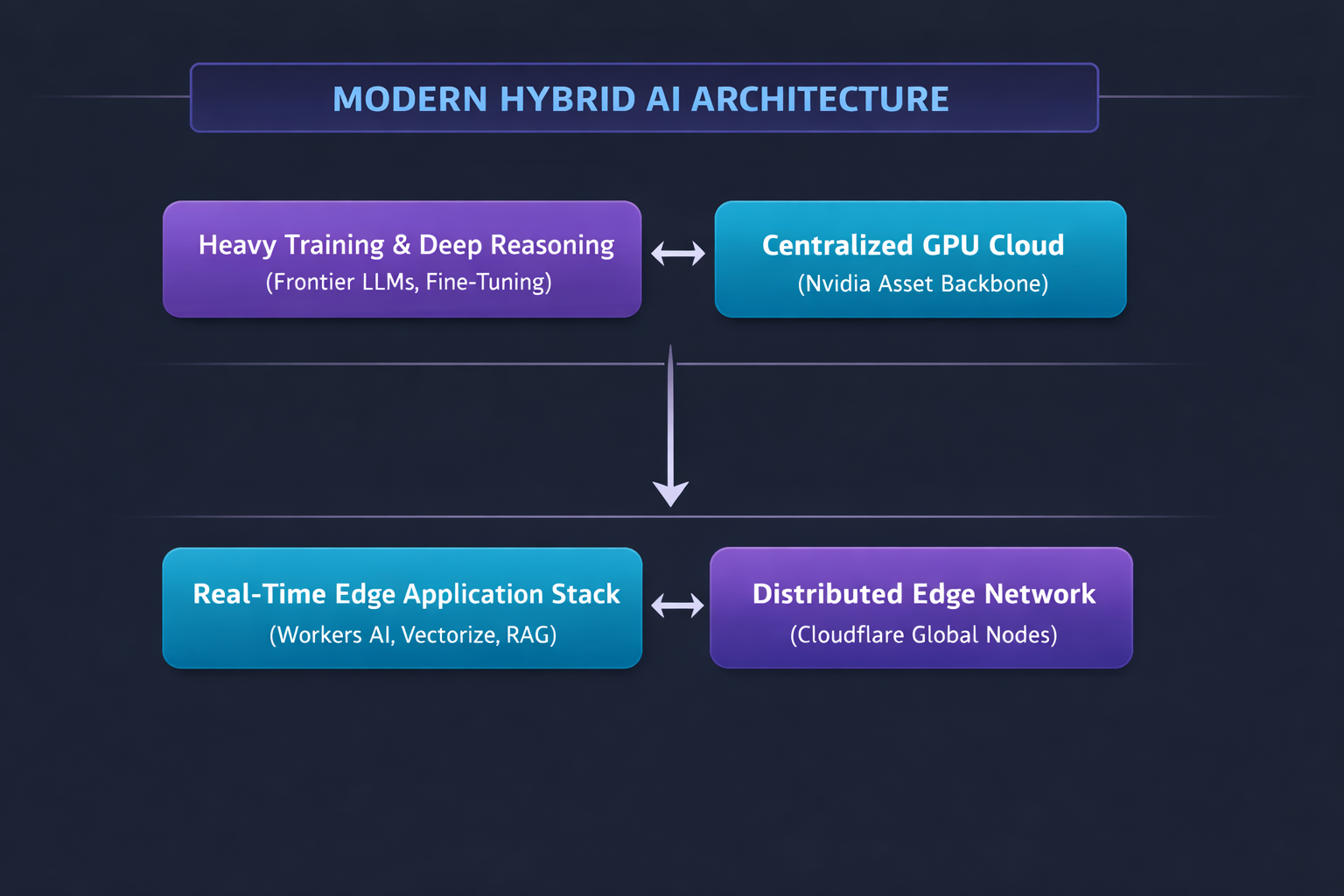
View ASCII source
+-----------------------------------------------------------------------+
|                    MODERN HYBRID AI ARCHITECTURE                      |
+-----------------------------------------------------------------------+
|                                                                       |
|   [ Heavy Training & Deep Reasoning ]  <-->  Centralized GPU Cloud    |
|   (Frontier LLMs, Fine-Tuning)               (Nvidia Asset Backbone)  |
|                                                                       |
|                                 |                                     |
|                                 v                                     |
|                                                                       |
|   [ Real-Time Edge Application Stack ] <-->  Distributed Edge Network |
|   (Workers AI, Vectorize, RAG)               (Cloudflare Global Nodes)|
|                                                                       |
+-----------------------------------------------------------------------+
1. Re-evaluate Infrastructure Spend and Hardware Dependency
Businesses building AI products must decouple their application logic from single-provider dependencies. Relying exclusively on high-cost closed APIs can erode software gross margins as request volume scales. Teams should audit their workflows to determine which features genuinely require ultra-large foundation models and which can be offloaded to smaller, fine-tuned models running on serverless edge networks.
2. Embrace Modern Edge-Native Tooling
Developers no longer need to spend dozens of engineering hours orchestrating Kubernetes clusters, tuning Docker containers, or managing cold starts just to deploy an open-source machine learning model. Utilizing integrated edge platforms enables small, agile product teams to ship full-stack AI features—from database writes to vector search and model generation—in a fraction of the traditional development timeframe.
3. Implement Strict AI Observability and Cost Control
With compute operating as a scarce asset, cost management is paramount. Platforms featuring built-in AI gateways allow developers to cache common model prompts, automatically route requests to the lowest-cost available model, and enforce real-time rate limits. Implementing prompt caching alone can reduce model API overhead by up to 60%.
Future Outlook: The Next 6 to 12 Months
Over the next year, the financialization of compute and the distribution of edge AI stack capabilities will accelerate, driving several key trends across the technology landscape:
- Dynamic Compute Derivatives: Expect the financial industry to introduce formalized futures contracts, compute options, and hedging instruments tied directly to GPU processing hours. Enterprise companies will regularly hedge their future compute costs just as airlines hedge jet fuel prices today.
- The Rise of Sovereign AI Compute: Nation-states are beginning to view GPU clusters as critical national infrastructure. Governments will continue establishing localized compute reserves to ensure national security, domestic scientific research, and technological sovereignty.
- Predominance of Edge-Native RAG: As open-source small language models (SLMs) grow more capable, context retrieval and inference will shift almost entirely to local edge networks. Applications will run local vector searches against ultra-low-latency distributed databases, generating user responses in milliseconds.
- Automated Multi-Cloud Load Balancing: Advanced orchestrators will automatically direct machine learning inference requests across global providers based on real-time spot prices for compute, latency metrics, and strict regional data compliance regulations.
Conclusion
The artificial intelligence boom has moved far beyond simple chat interfaces and experimental wrappers. We have entered an era defined by massive hardware asset classes on one end and highly distributed, serverless developer stacks on the other. Nvidia’s role as the financial backbone of raw compute power, paired with Cloudflare’s full-stack edge ecosystem, demonstrates how software development is evolving.
For modern businesses and technical leaders, success no longer hinges on owning the largest server cluster or writing every infrastructure layer from scratch. Instead, it relies on speed, architectural efficiency, and leveraging modern edge infrastructure to deliver intelligent software to users instantaneously. The infrastructure is ready—it is now up to builders to ship the future.
Build With Developers of Chicago
If this kind of AI capability matters to your product, you need a team that can actually ship it. Developers of Chicago helps startups and enterprises design, build, and deploy AI-powered software — from custom integrations to full-scale automation systems.
- AI Integration & Automation — Explore our AI services
- Custom Software Development — See our services
- Mobile App Development — Build with us
- Start a Project — Book a call
Based in Chicago. Building for clients everywhere.